
When the Story Meets the Evidence
Most M&A processes open with a persuasive narrative. Revenue is healthy, EBITDA is strong, the addressable market is expanding, and the value-creation opportunities look self-evident. An indicative offer follows, a letter of intent is signed, and a data room opens.
Then the questions sharpen. What portion of earnings is genuinely recurring? Which customers are contractually bound? Why did receivables outpace revenue?
Due diligence is the point at which a transaction shifts from narrative to evidence. Buy-side financial due diligence typically examines the quality of earnings, potential debt-like items, working capital trends, and tax exposures that may affect value or crystallise after closing, while a broader review extends into commercial, operational, legal, technology, cyber, ESG, and human-capital risk (PwC India).
The buyer's real question is rarely “is this a good company.” It is closer to: is this the company we underwrote, at the economics and risks we can price and manage. When the answer turns to “no,” walking away can be the more rational outcome.
The Central Issue: A Crisis of Conviction
No target is flawless, and the presence of a weakness rarely kills a deal on its own. What matters is whether a finding is material to the investment thesis, difficult to quantify or mitigate, or discovered late enough to erode trust. A disclosed weakness is negotiable; a weakness uncovered only after repeated assurances suggests other issues may still be hidden.
Every transaction must also clear a buyer's internal strategic, financial, risk, financing, integration, and governance tests, and a finding that is tolerable in isolation can become unacceptable once it weakens several of these simultaneously.
Where Conviction Erodes
Earnings that do not hold up
The most common source of concern is maintainable earnings. Sellers often present EBITDA inflated by add-backs for owner compensation, “non-recurring” costs, or excluded overhead that the buyer will incur regardless.
Financial diligence assesses revenue and profit quality, maintainable EBITDA, working capital, and net debt against this more demanding standard, and quality-of-earnings adjustments exist precisely to test the sustainable level of EBITDA on a standalone basis (PwC India). A modest shift in accepted add-backs can move enterprise value by a double-digit percentage at typical transaction multiples , and can reveal that the valuation itself was never adequately supported.
Forecasts that require too much faith
Buyers grow cautious when projected growth sharply exceeds historical performance, when pipeline is treated as committed revenue, or when margin expansion is assumed without an implementation plan. Forecast credibility is as much behavioural as quantitative: it depends on whether management separates assumptions from facts and can reconcile the plan to customer- and product-level detail. Deloitte's 2024 poll of M&A professionals found economic uncertainty to be the leading driver of heightened diligence, followed by integration planning and tougher lending conditions (Deloitte 2024) , a reminder that forecasts are judged against a broader climate of caution, not in isolation.
Working capital that is lower than it appears
Apparent efficiency can mask delayed supplier payments, accelerated collections, or inventory run down below sustainable levels. Working-capital trends and the normalized level required to operate the business are core components of buy-side diligence and a peg set too low can force the buyer to inject cash immediately after closing.
Debt-like items hiding on the balance sheet
Enterprise value is not equity value. Finance leases, deferred consideration, unpaid capex, and unfunded commitments are examples of off-balance-sheet liabilities that can crystallise shortly after completion (Forvis Mazars). Late-discovered liabilities are damaging less for their size than for what they imply , that other undisclosed items may remain.
Concentration and key-person dependence
A target can look diversified in aggregate while remaining fragile at the customer or founder level. Buyers test contract duration, renewal history, and whether relationships are institutional or founder-owned, and they interview customers and management to probe consistency. Data analytics can help surface unusual revenue patterns, customer churn, and product-level profitability that an income statement alone conceals (KPMG Ireland, 2025).
Legal, tax, IP, and integration exposure
Financial diligence identifies a problem; legal and tax diligence determines whether it is survivable. Heightened economic stress, uncertain financing markets, and closer regulatory scrutiny have made robust diligence and carefully negotiated protections more important (Skadden, 2022), and directors are increasingly expected to interrogate contractual disputes, unresolved enforcement matters, and contingent liabilities before approving a transaction (Skadden, 2022).
Intellectual property ownership, licensing, and transferability raise similar questions for technology-driven targets, while integration diligence tests whether anticipated synergies survive contact with incompatible systems, contracts, and cultures , a workstream PwC identifies as central to realising deal value (PwC India).
Weak systems and a trust deficit
Diligence is, in large part, an exercise in reconciliation. A single discrepancy is explainable; a pattern of them signals uncertainty about the business itself. Analytical tools can automate cleansing, aggregation, and anomaly detection, but technology cannot substitute for management's ability to explain what the numbers show. (KPMG Ireland, 2025).
When the deal's own economics move
Financing can quietly withdraw support for a price that once looked sound, particularly as lenders apply more conservative EBITDA multiples or tighten covenants amid costlier borrowing and more selective capital allocation. Equally, a buyer's own strategy can shift mid-process , a board priority changes, a champion departs, or a stronger opportunity appears , reasons that have little to do with the target itself (Madrid, 2023).
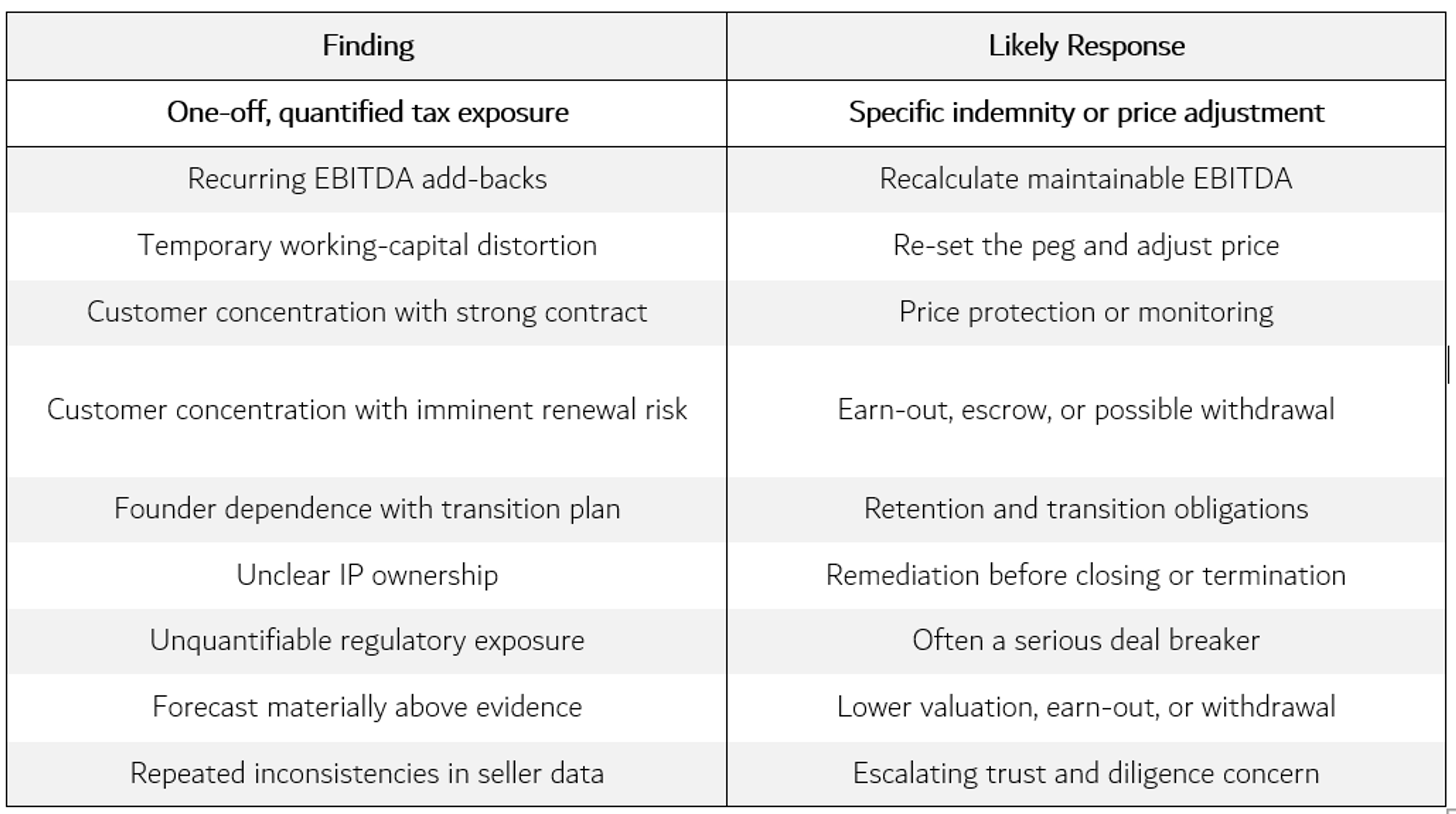
A Framework for Separating Fixable Issues from Deal Breakers
Not every finding warrants the same response. A practical approach weighs each issue by materiality, probability, time horizon, mitigability, and , decisively , its impact on trust in the rest of the seller's disclosures.
What This Means for Both Sides of the Table
For sellers, the discipline is preparation: a reconciled financial story, a sell-side quality-of-earnings review, organised customer and contract data, and early identification of key-person exposure all reduce the odds of a late-stage surprise. Prolonged bidder diligence itself erodes value , Deloitte's 2024 Global Corporate Divestiture Survey found that a lack of exit and separation readiness was the most cited reason sellers received less than expected in a recent divestiture (Deloitte, 2024).
For buyers, discipline means anchoring diligence to the investment thesis rather than a generic checklist, classifying findings early as fatal, fixable, or immaterial, and communicating concerns clearly enough that a seller can respond rather than simply absorb a collapsing process.
Buyers Walk Away from Uncertainty, Not Imperfection
Buyers rarely abandon a transaction because a target has problems; every target does. They walk away when the problems are larger, less predictable, or less quantifiable than the deal thesis allowed, when the acquisition stops resembling an investment and starts resembling a bet.
The strongest transactions are not the ones without red flags. They are the ones in which red flags surface early, their economic consequences are understood, and both sides decide, rationally, whether to fix them, price them, protect against them, or part ways.
Precision under scrutiny is built long before a data room opens.
Yajur Knowledge Solutions partners with investment banks, M&A advisors, and growing businesses to build the information memoranda, financial models, and management materials that are engineered to withstand exactly this kind of examination , pairing decades of deal-execution experience with AI-enabled research and analytics so clients arrive at diligence with a defensible story, not a fragile one.
References
- Deloitte. (2024). *Acquirer M&A due diligence trends poll data.*
- Deloitte. (2024a). *2024 Global Corporate Divestiture Survey: Amid uncertainty, new muscles for new possibilities.*
- Forvis Mazars. (n.d.). *Financial due diligence.*
- KPMG Ireland. (2025). *Data analytics increasingly important in M&A financial due diligence.*
- Madrid, M. (2023). *Top 8 reasons buyers walk away from an M&A deal.* Exit Advisors.
- PwC. (n.d.). *Acquisitions and integrations.*
- PwC India. (n.d.). *Buy-side financial due diligence.*
- Skadden, Arps, Slate, Meagher & Flom LLP. (2022). *US M&A levels remain healthy, but due diligence and deal protections will become even more critical.*
- Skadden, Arps, Slate, Meagher & Flom LLP. (2025). *Critical questions directors should ask during M&A due diligence.*