Mergers and acquisitions are often framed as a contest between analytical precision and human intuition. In practice, this dichotomy is misleading. The most successful transactions are rarely driven by one at the expense of the other, they emerge from a calibrated interplay between structured data and experienced judgment.
M&A is not a singular decision but a sequence of interdependent judgments under uncertainty, screening targets, validating financials, assessing strategic fit, navigating negotiations, and executing integration. At each stage, the relative weight of data and instinct shifts. Understanding when each should lead, and when it should challenge, is what differentiates disciplined dealmakers from reactive ones.
The False Dichotomy
The notion that data is inherently objective while instinct is inherently biased oversimplifies decision-making in M&A. Data is only as reliable as the assumptions that shape it. Instinct, conversely, is not merely emotional, it is often a compressed form of pattern recognition built over years of domain exposure and deal experience (Bakar & Mahmood, 2023).
Empirical research suggests that senior executives do not rely exclusively on either mode; instead, they dynamically integrate both, particularly in environments characterized by incomplete or ambiguous information. The implication is clear: instinct should not replace data, but neither should it be dismissed. It should interrogate it.
Where Data Leads, and Why It Matters
Data demonstrates its strongest utility in domains that are measurable, comparable, and testable. In M&A, this includes financial diagnostics, operational metrics, and structured scenario analysis.
Key areas where data should dominate :
- Target screening: Systematic filtering based on financial performance, market positioning, and strategic alignment.
- Due diligence: Evidence-based validation of revenue quality, cost structures, liabilities, and contractual dependencies.
- Valuation and scenario modeling: Sensitivity analysis across growth assumptions, synergies, and downside risks.
- Integration planning: Defining milestones, tracking synergies, and aligning operational benchmarks.
Advanced analytics has significantly expanded the scope of what data can reveal. Contemporary deal teams increasingly leverage broader datasets, market signals, customer-level insights, and competitive dynamics, to move from reactive evaluation to predictive judgment (Cremades, 2019; Grata, 2025).
Notably, machine learning applications in M&A have demonstrated the ability to distinguish value-creating deals from value-destructive ones with meaningful accuracy, reinforcing the role of data in improving decision quality (SSRN, 2024).
Yet, data does not make decisions, it refines them. Its primary strength lies in narrowing ambiguity, not eliminating it.
Where Instinct Leads, and Why It Endures
Instinct becomes indispensable when decisions extend beyond quantifiable variables. Strategic alignment, leadership quality, cultural compatibility, and negotiation dynamics often resist precise modeling.
Instinct is particularly valuable in:
- Strategic fit assessment: Evaluating whether a target aligns with long-term vision and capability evolution.
- Cultural compatibility: Interpreting leadership styles, organizational behaviors, and decision-making norms.
- Negotiation dynamics: Reading intent, tone, and behavioral signals that formal disclosures cannot capture.
Experienced dealmakers frequently identify risks that models overlook, a leadership misalignment, a fragile customer relationship, or an overly curated narrative. Research highlights that intuition enables executives to synthesize weak signals and detect inconsistencies that are not immediately visible in structured datasets (Emerald Insight; Tampere University).
However, instinct must be treated as a hypothesis generator, not a conclusion. Its role is to prompt deeper inquiry, not bypass it.
The Risks of Imbalance
Overreliance on Instinct
While valuable, instinct is susceptible to cognitive distortions:
- Overconfidence and confirmation bias
- Anchoring to prior deal experiences
- Sunk cost fallacy in late-stage negotiations
Unchecked intuition can transform experience into rigidity, particularly when past success is mistaken for universal applicability.
Overreliance on Data
Conversely, excessive dependence on data introduces its own risks:
- Analysis paralysis: Endless modeling without decisive insight
- False precision: Overconfidence in outputs driven by flawed assumptions
- Blind spots: Inability to capture qualitative factors such as trust, morale, or leadership credibility
In such cases, data creates the illusion of certainty while masking underlying ambiguity (Cremades, 2019).
A Stage-Based Decision Framework
Rather than choosing between data and instinct, effective dealmaking requires assigning each a primary and secondary role across the deal lifecycle.
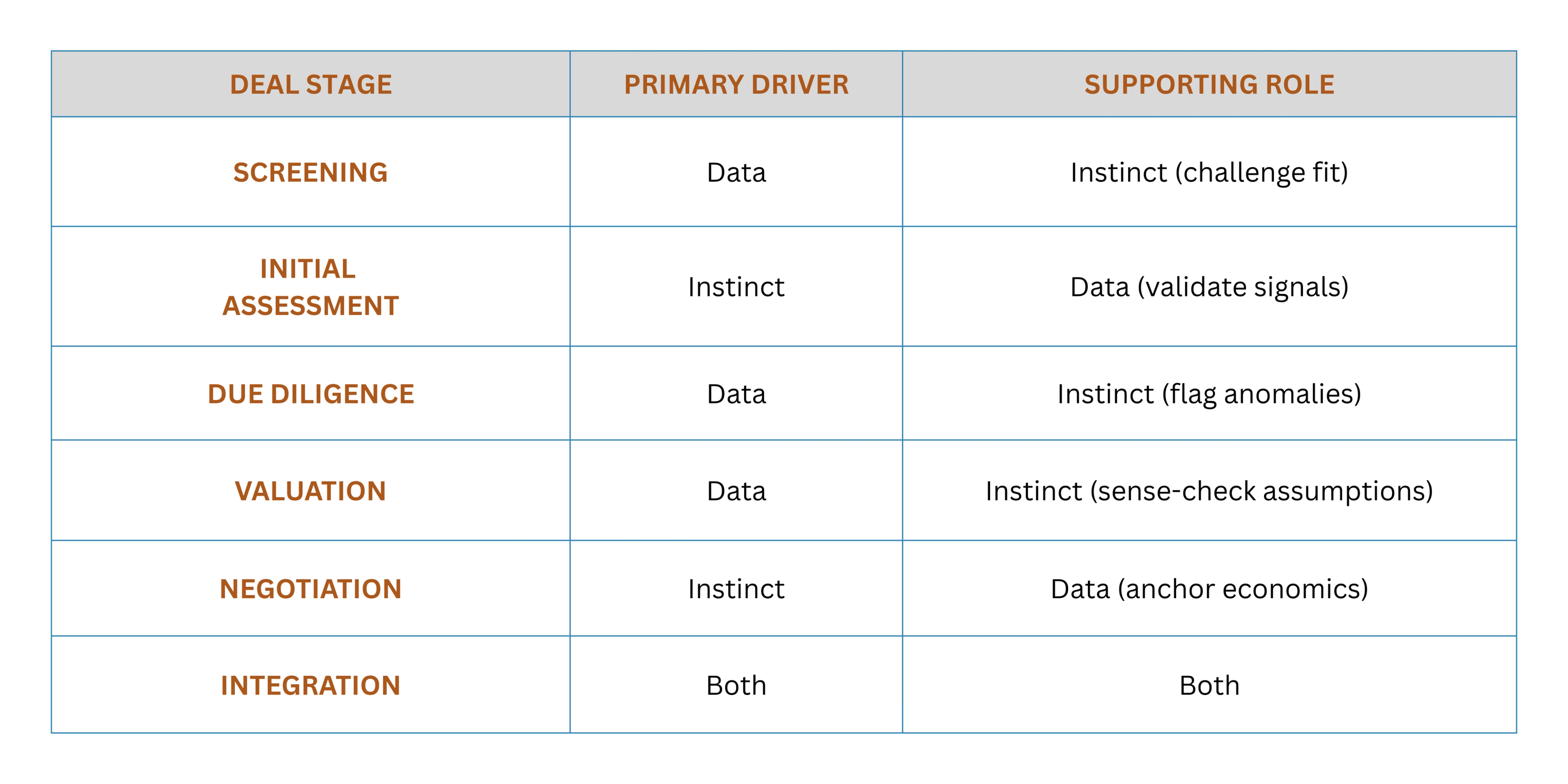
This framework ensures that decisions remain both evidence-based and context-aware. It also prevents either mode from operating unchecked.
Culture: The Convergence Point
One of the most critical, and least quantifiable, dimensions of M&A is cultural integration. Research consistently underscores that cultural misalignment is a leading cause of post-merger underperformance (McKinsey & Company, 2024; PwC, 2021).
While data can identify proxies, employee turnover, engagement scores, decision latency, true cultural compatibility often requires interpretive judgment. The most effective teams translate intuitive assessments into observable indicators, ensuring that cultural insights inform structured integration plans.
The Evolving Role of Data: From Descriptive to Predictive
The evolution of AI and machine learning is reshaping the data-instinct balance. Predictive models are increasingly capable of identifying patterns across deal outcomes, sector trends, and operational performance.
However, even the most advanced models remain dependent on human interpretation. Algorithms can highlight correlations; they cannot fully contextualize intent, leadership dynamics, or strategic nuance.
The future of M&A decision-making, therefore, is not automation, but augmentation. Data enhances judgment; it does not replace it.
The Learning Loop: Refining Judgment Over Time
Experience alone does not improve instinct, feedback does. The most effective dealmakers institutionalize learning by:
- Comparing expected vs. realized deal outcomes
- Revisiting failed or underperforming transactions
- Challenging assumptions embedded in past decisions
This iterative process refines both analytical models and intuitive judgment, creating a compounding advantage over time (SSRN, 2024).
Implications for M&A Advisors
For advisors, the mandate is clear: deliver insight, not just information.
Clients do not seek data in isolation, they seek clarity. This requires:
- Translating complex analyses into actionable narratives
- Identifying which variables matter most
- Challenging assumptions embedded in both models and management narratives
High-quality advisory increasingly sits at the intersection of financial rigor, strategic context, and interpretive insight.
A Discipline, Not a Preference
The question is not whether to trust instinct or data it is when to trust each, and how to ensure they remain in productive tension.
- Trust data when the problem is measurable and the cost of error is quantifiable.
- Trust instinct when the problem involves human behavior, ambiguity, or incomplete information.
- Demand that each challenges the other.
The most effective M&A decisions are not driven by conviction alone, but by disciplined interrogation of numbers, narratives, and assumptions alike.
In this context, the role of specialized partners becomes increasingly critical.
Yajur Knowledge Solutions bring together structured research, advanced financial modeling, and insight-led storytelling to support decision-making where both precision and perspective are required. As deal environments grow more complex, this integration of analytical depth and strategic clarity is no longer differentiated—it is essential.
References
Bakar, H. A., & Mahmood, R. (2023). The role of intuition in CEO acquisition decisions. Journal of Business Research.
Cremades, A. (2019). The role of data analytics in M&A decision-making.
Grata. (2025). Data analytics in M&A: Transforming deals & decisions.
McKinsey & Company. (2024). The importance of cultural integration in M&A: The path to success.
PwC. (2021). How culture can create value during M&A integration.
What Is the Deal?: Predicting M&A Outcomes with Machine Learning. (2024). SSRN Paper.
Emerald Insight. M&As get another assist when CEOs add intuition.
Tampere University Repository. M&As get another assist.
Salesforce. Data versus instinct in decision-making.