Selling a business is often framed as a valuation exercise. In practice, it is closer to a credibility exercise. A buyer does not simply ask what a business earned last year; they ask how those earnings were generated, how repeatable they are, and whether they will still exist once the transaction closes and the seller is no longer in the room. That distinction, between reported profit and earning power, is precisely what quality of earnings, or QoE, exists to test (Morgan & Westfield, n.d.; Baker Tilly, 2022).
A strong QoE review can shape price, terms, timing, and buyer confidence. A weak or absent one invites doubt, triggers deeper diligence, and reduces what a buyer is willing to pay. For sellers preparing to go to market, understanding QoE early is not simply useful, it is part of preparing the business itself for scrutiny (CBV Institute, 2024).
Why QoE Matters
At its core, a quality of earnings analysis is a third-party review of whether reported earnings are accurate, sustainable, and representative of future performance. It is not the same thing as an audit, and the distinction is consequential. An audit assesses whether financial statements comply with accounting standards. A QoE analysis is designed to help buyers and sellers understand the economic earnings of a business in an M&A context, a fundamentally different question (Morgan & Westfield, n.d.; Baker Tilly, 2022).
That difference matters because financial statements can be technically correct and still be a poor guide to value. A company may report healthy net income while cash flow lags behind it, or its results may include one-time benefits, unusual expense timing, or accounting decisions that inflate the apparent run rate. QoE exists to separate what is recurring from what is temporary, and what is real operating strength from what is merely presentation (Corporate Finance Institute, n.d.).
The practical question behind every QoE review is disarmingly simple: if the buyer owned this business tomorrow, how much of the reported profit would still exist? That single question is why earnings quality is so closely tied to cash generation, sustainability, and the operational drivers sitting beneath the income statement (CRI Adv, 2024).
What Buyers Look For
Buyers typically use QoE to validate EBITDA, understand cash flow conversion, and identify risks that could affect valuation or post-close performance. In middle-market transactions, this diligence frequently extends to revenue recognition testing, gross margin review, working capital analysis, and close scrutiny of non-recurring or non-core items (HCVT, n.d.).
A buyer is, ultimately, trying to understand how dependable the business's cash flows really are. If reported profits are trapped in receivables, distorted by inventory issues, or propped up by non-recurring items, the business may deserve a lower multiple even when headline earnings look attractive. In that sense, QoE is not merely an accounting exercise, it functions as a valuation filter (Baker Tilly, 2022).
For private equity buyers, lenders, and boards specifically, QoE also provides a basis for confidence in the underlying investment thesis. It tests whether the seller's narrative holds up under scrutiny, and whether the business can support debt service, earn-outs, or integration assumptions after close (CBV Institute, 2024).
What Sellers Gain
For sellers, a sell-side QoE can be one of the most valuable preparatory steps before going to market. It allows management to view the business through a buyer's eyes, resolve weaknesses early, and reduce the risk of late-process surprises (CBIZ, 2023).
That preparation translates directly into negotiation leverage. A seller who understands how EBITDA is likely to be adjusted, which items buyers may challenge, and where the business has clean, defensible support finds it considerably easier to hold firm on value. A well-prepared QoE also organizes the data room, accelerates diligence, and lowers the probability that a buyer discovers something material for the first time late in the process, precisely the moment such discoveries are most damaging (Morgan & Westfield, n.d.).
Just as importantly, a sell-side QoE helps establish a credible net working capital target. In many transactions, price adjustments are driven not only by earnings quality but by how much working capital the buyer needs to operate the business from day one. A poorly considered target is a common, and avoidable, source of purchase price disputes after closing (HCVT, n.d.).
Core Components of a QoE Review
QoE reports vary by industry and deal size, but they generally follow a recognizable structure. A typical review begins with historical financial statements, interim results, tax returns, bank statements, forecasts, and management interviews, before moving into adjustments and normalization of the reported numbers (Morgan & Westfield, n.d.).
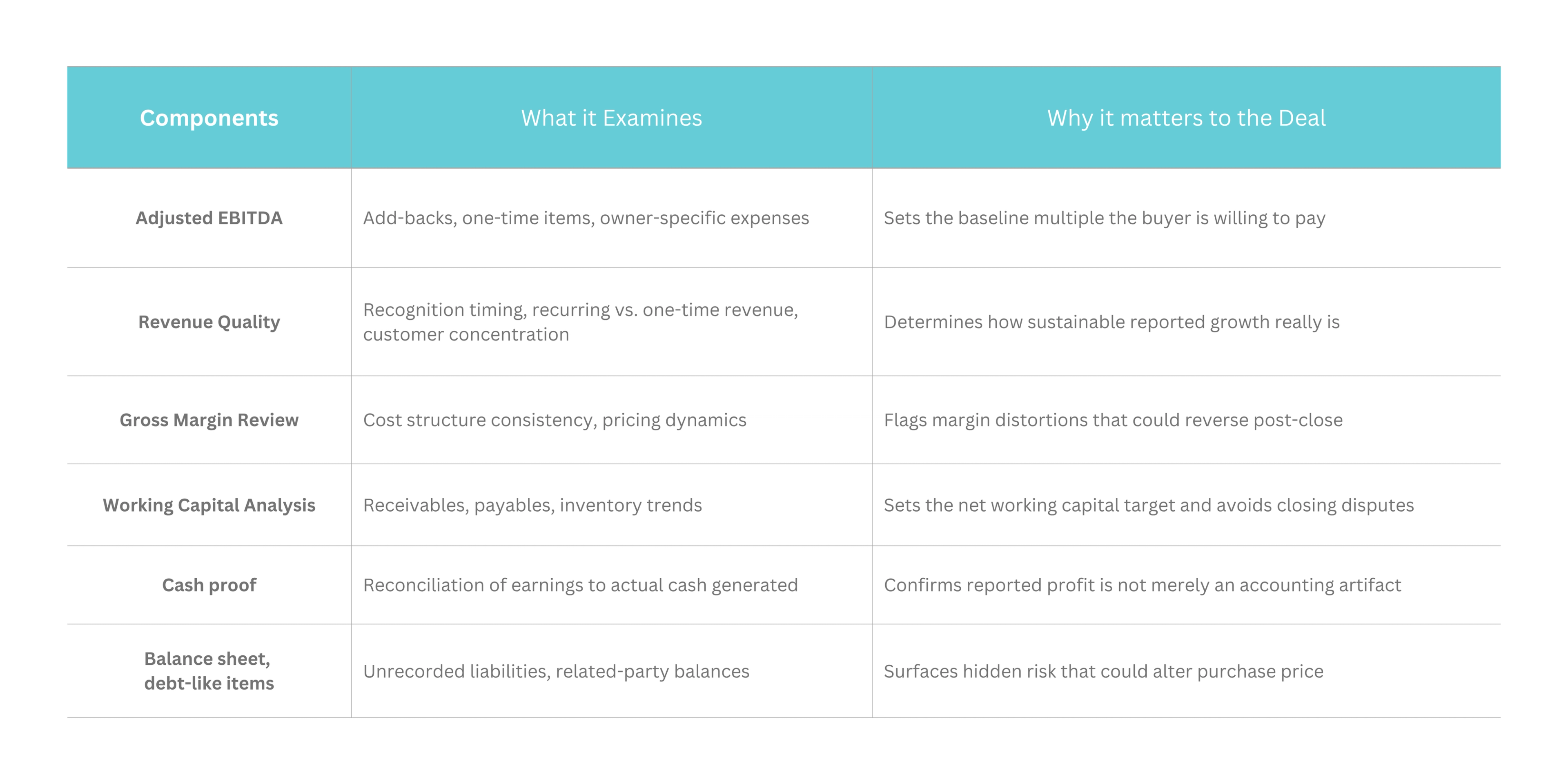
A thorough QoE goes well beyond EBITDA alone, examining the mechanics underneath it, revenue quality, margins, operating expenses, balance sheet accounts, cash proof, debt-like items, and working capital, and, critically, treats these elements as connected rather than as separate boxes to tick (HCVT, n.d.).
A useful way to frame the exercise is that QoE asks three linked questions. Are the numbers accurate? Are they repeatable? And do they describe the business the buyer will actually own after the deal closes? That combination is what turns a financial statement review into genuine transaction intelligence (CBV Institute, 2024; CRI Adv, 2024).
EBITDA and Normalization
EBITDA sits at the center of most M&A discussions because it functions as a common proxy for operating performance. QoE practitioners, however, treat reported EBITDA as a starting point rather than an endpoint. The substantive work lies in adjusting for items that do not reflect normal operations, do not recur, or are not genuinely supported by the underlying business model (Corporate Finance Institute, n.d.).
Common adjustments include owner compensation set above market rate, personal expenses run through the business, one-time legal or restructuring costs, unusual bonuses, and revenue or expenses recorded in the wrong period. Buyers expect each add-back to be supported by documentation rather than management explanation alone, and the more subjective an adjustment, the more likely it is to be challenged (Baker Tilly, 2022).
This is precisely where sellers most often run into difficulty. An adjustment that appears persuasive internally may not survive buyer diligence unless it is documented, reasonable, and consistent with the business's normal operating pattern. A disciplined QoE process functions as a stress test for every add-back and every assumption embedded in adjusted EBITDA (Morgan & Westfield, n.d.).
Cash and Working Capital
One of the most important lessons from QoE work is that earnings and cash are not the same thing. Earnings can be recognized before cash is received, and cash itself is shaped by timing, working capital swings, and capital spending decisions. That is why most QoE reports include a proof of cash and a close review of working capital accounts (Baker Tilly, 2022).
Working capital matters because many deals are priced on a cash-free, debt-free basis and then adjusted based on the net working capital required to run the business going forward. If the target is set too low, the buyer may need to inject cash immediately after closing. If it is set too high, the seller may leave value on the table or face disputes at closing. QoE gives both sides a way to discuss this issue using historical evidence rather than negotiation guesswork (HCVT, n.d.).
This is also why buyers pay close attention to collections, inventory movement, and receivable aging. Profitability that looks strong on paper can still be weak in practice if the company takes too long to convert revenue into cash. A business with growing revenue but deteriorating receivable quality may merit a meaningfully different valuation than one with identical EBITDA but stronger cash conversion (CBV Institute, 2024).
Revenue Quality
Revenue quality is another central pillar of QoE. Buyers want to know whether revenue is recurring, diversified, and supported by stable customer relationships, or whether it depends on a handful of large accounts, irregular contracts, or unusual timing effects. Revenue concentration and customer dependency are consistently flagged as core diligence concerns (Morgan & Westfield, n.d.).
Revenue recognition itself is equally critical. If revenue is booked too early, too late, or inconsistently relative to company policy and accounting standards, reported EBITDA can be meaningfully distorted. In some cases, a QoE review reveals that sales are real but not sustainable at the same level, particularly if revenue was pulled forward, aided by one-time pricing events, or supported by unusually favorable but temporary conditions (Corporate Finance Institute, n.d.).
For sellers, this does not necessarily signal bad news, it signals that the narrative needs to be framed correctly. A business with cyclical, contract-based, or concentrated revenue can still be a strong asset, but the market will want to understand precisely how much of that revenue is repeatable and what protections exist if a key customer or product line changes (CRI Adv, 2024).
Red Flags in Diligence
Certain issues surface repeatedly in QoE work. Aggressive accounting, weak documentation, unrecorded liabilities, poor inventory controls, related-party transactions, and inconsistent internal controls all weaken buyer confidence. These are not purely accounting concerns, they function as deal-risk signals (Morgan & Westfield, n.d.).
Related-party dealings warrant particular attention, because they can make profit appear stronger than it actually is. If a business pays below-market rent to an owner-controlled entity, or receives favorable pricing from a related supplier, historical EBITDA may not reflect post-close economics at all. Buyers want clarity on whether such arrangements are arm's-length and whether they will continue once the transaction closes (CBV Institute, 2024).
Other red flags are operational rather than accounting-based: customer concentration, dependence on key individuals, aging equipment, supply chain fragility, and thin internal controls all suggest that earnings may be more fragile than the income statement implies. In a sale process, these risks frequently translate into lower multiples, additional earn-outs, tighter representations and warranties, or a longer post-close transition period (Baker Tilly, 2022).
Timing and Process
QoE is typically introduced after the letter of intent, during the due diligence phase, when the buyer has exclusivity and wants to validate the business before finalizing price and terms. In practice, the resulting report becomes part of the buyer's financial diligence package and directly influences negotiations around valuation, working capital, debt, and other closing mechanics (Morgan & Westfield, n.d.).
The process itself generally involves information gathering, management discussions, statement adjustments, detailed testing, and report delivery. Depending on business complexity and the speed of information flow, the process can take several weeks. The objective, regardless of scope, remains constant: give the deal team a clearer, more reliable view of the business's true earning power (Baker Tilly, 2022).
For sellers, this timing creates a critical strategic insight. Waiting until a buyer asks difficult questions is usually too late to shape the narrative. Commissioning a sell-side QoE before launching the process allows a company to identify issues, support its add-backs, and present a more credible, organized story from the very first serious conversation onward (CBIZ, 2023).
Why It Shapes Value
In M&A, price is rarely determined by last year's profit alone. It is determined by the buyer's confidence in future cash flows, the clarity of the financial story, and the perceived risk of unpleasant surprises after close. QoE directly shapes all three (Corporate Finance Institute, n.d.).
That is why a clean QoE can support a meaningfully higher multiple. Buyers are often willing to pay more for a business that looks easy to diligence, easy to finance, and easy to integrate. Conversely, a report that reveals weak controls, shaky add-backs, or earnings overly dependent on unusual circumstances tends to invite a lower valuation or tougher deal terms (Baker Tilly, 2022).
This is the quiet power of QoE. It does not change the underlying business overnight, but it changes how the market interprets that business. And in a sale process, interpretation very often becomes price (CBV Institute, 2024).
A business owner preparing for sale is not only selling performance, they are selling trust. Quality of earnings brings discipline to that trust by separating recurring earnings from temporary noise, supportable numbers from optimistic ones, and transferable value from owner-dependent value. The result is a clearer transaction, fewer surprises, and a sturdier foundation for negotiation (Morgan & Westfield, n.d.).
For sellers, the best time to understand QoE is before the market does. For buyers, the right moment to request it is before the deal moves from interest to commitment. In either direction, QoE is not a side document — it is one of the primary tools for converting financial history into a realistic, defensible view of value (CRI Adv, 2024).
Yajur Knowledge Solutions supports investment banks, M&A advisors, and corporate finance teams with the research rigor and analytical precision that diligence-grade work demands, from building defensible adjusted EBITDA narratives to interrogating revenue quality and working capital dynamics ahead of a sale.
As deal teams increasingly look to combine domain expertise with technology-enabled research, the discipline behind a credible quality of earnings story remains a constant: getting the numbers right, the first time, before the market asks the hard questions.
References
Baker Tilly. (2022). Ten considerations in a quality of earnings study.
CBIZ. (2023). Sell-side quality of earnings: A critical part of due diligence.
CBV Institute. (2024). Sponsored research paper: Quality of earnings best practices.
Corporate Finance Institute. (n.d.). Quality of earnings report.
CRI Adv. (2024). A quality of earnings analysis: What it is, and why buyers need it.
HCVT. (n.d.). Quality of earnings analysis needed in M&A transaction.
Morgan & Westfield. (n.d.). Quality of earnings in M&A - The ultimate guide.