For most of private equity and M&A history, deal origination was a craft. It rewarded the banker with the right Rolodex, the fund manager with deep sector relationships, and the corporate development team that heard about an asset before anyone else did. That model has not disappeared, but it has been substantially disrupted.
In an environment of intense competition, compressed decision timelines, and abundant dry powder chasing a finite universe of quality assets, firms that embed data, AI, and alternative information into their origination processes are identifying targets faster, filtering more precisely, and converting more selectively (Bain & Company, 2026). Those that do not are increasingly reactive, chasing fully intermediated processes in which they are one of many bidders, rather than entering early as a known, credible counterpart.
The question for investment banks, private equity funds, M&A boutiques, and corporate development teams is no longer whether data-driven origination is relevant. It is whether their current capabilities are sufficient for the competitive environment already here.
From Art to System: What Changed and Why
Origination has traditionally been anchored in networks, intermediaries, and opportunistic inbounds, a relationship-intensive, geographically bounded model that favored repeat players with strong banker coverage and established industry reputations (Affinity, 2026). The logic was circular and durable: good relationships produced deal flow; deal flow produced track records; track records attracted better relationships.
Three structural forces have disturbed that equilibrium.
Volume and complexity have increased. The growth and professionalization of private markets has intensified competition for high-quality assets, raising expectations around both speed and analytical depth in decision-making (McKinsey, 2026). Evalueserve's case work with a U.S.-based PE firm describes a team facing a surge in deal flow and needing to analyze thousands of companies under severe time constraints, a problem that no amount of additional analyst headcount could solve sustainably (Evalueserve, 2023).
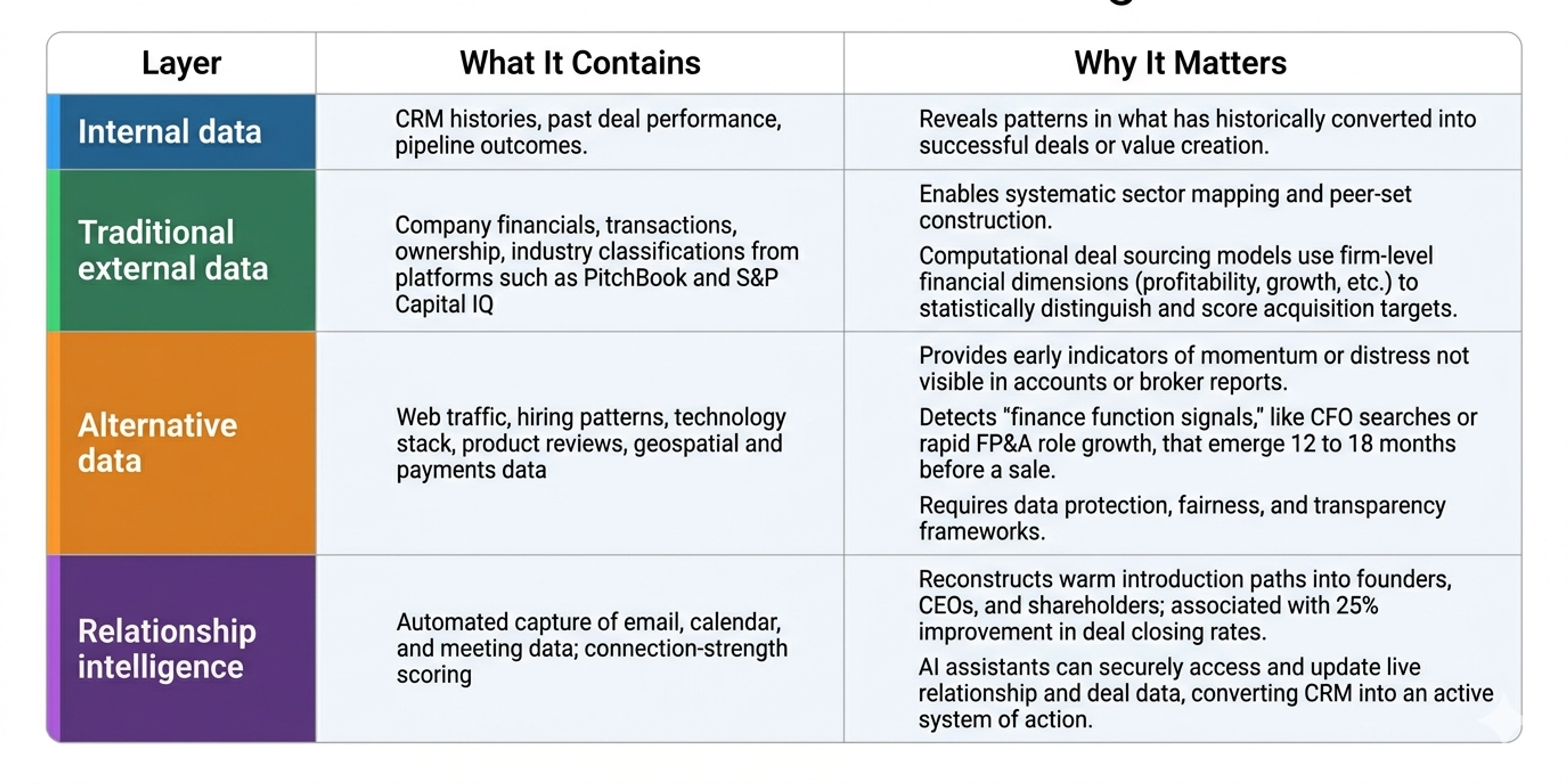
Data availability has expanded dramatically. KPMG notes that exponential growth in data and processing power is shifting M&A diligence from largely qualitative assessments toward quantitative and predictive analyses (KPMG, 2025). Companies, including private ones, now leave extensive digital footprints: in hiring patterns, web traffic, technology stack choices, customer reviews, and social sentiment. These signals carry real information about momentum, stress, and strategic intent, often long before a banker's teaser reaches a deal team.
Technology has made continuous scanning realistic. Bain's 2026 M&A report finds that AI use in M&A more than doubled in 2025, with 45% of surveyed executives relying on AI tools, most heavily in sourcing, screening, and diligence (Bain & Company, 2026). PwC's 2026 M&A outlook argues that AI investments are creating a "K-shaped" market in which large, confident acquirers deploy these tools to drive megadeals while others risk falling behind if they cannot articulate a differentiated, data-backed story (PwC, 2026).
Together, these forces make analog, network-only sourcing increasingly uncompetitive.
The Data Stack Behind Modern Origination
Analytics and AI Across the Origination Lifecycle
Data becomes competitive advantage only when analytics and AI are applied across three distinct stages of the origination workflow.
- Dynamic market mapping and early detection. Leading acquirers now build "dynamic pipelines" using AI-enabled software that continuously scans large universes for potential targets and refreshes shortlists based on broad data inputs, rather than maintaining manual lists that are infrequently updated (Bain & Company, 2026). Tools that filter on revenue growth, hiring trends, intellectual property filings, technology stack, or geographic expansion patterns allow teams to spot targets just as they begin to break out, months before a banker-led auction is underway, when relationship-building is still possible (Ben Gordon, 2026; Praxis Rock, 2026). Grata, now part of Datasite via its merger with SourceScrub, exemplifies this approach: rather than relying on rigid industry codes, it uses NLP to classify companies based on what they actually do, scraping websites, job postings, and social media to surface companies that traditional databases consistently miss (Praxis Rock, 2026).
- Pre-targeting and scoring. Once a universe is mapped, data-driven origination narrows it to high-probability candidates before human outreach begins. A LinkedIn analysis of enriched data for deal origination characterizes this as moving from broad, undirected sourcing to precise pre-transaction targeting, using advanced metrics such as financial performance, growth trajectories, and competitive positioning to surface prospects that genuinely fit a firm's mandate while filtering time-wasters (LinkedIn, 2024). Academic work on machine learning for M&A predictive analysis demonstrates that regression, neural networks, and ensemble techniques can forecast deal completion likelihood and post-deal performance with meaningful accuracy, helping investors focus on targets whose profiles fit desired patterns (SSRN, 2023).
- Continuous pipeline learning. The most mature origination engines do not treat scoring models as static. McKinsey's Dealscan.AI, a proactive deal-sourcing capability built on advanced analytics and generative AI, accelerates target identification and assessment by learning from past transactions and user feedback, continuously refining its recommendations as more outcome data accumulates (McKinsey, 2026). In this sense, AI-enabled origination can evolve into institutional memory for what "good" looks like for a specific investor mandate.
Evidence of Impact
The case for data-driven origination has moved well beyond theory. Quantitative evidence of its impact is accumulating across multiple dimensions.
A study on AI-driven deal sourcing in U.S. M&A finds that automated screening reduced deal identification time from six weeks to eight days, lowered transaction search costs by 42%, and allowed AI systems to process 40 times more potential targets than manual methods, with machine learning models achieving 78% accuracy in predicting successful deal completion (Zenodo, 2025).
In private equity, integrating an AI-driven platform into deal sourcing and diligence workflows reduced manual data collection by 40% and sharpened focus on high-potential opportunities, improving resource allocation across the deal cycle (Brownloop, 2025). Evalueserve's case study describes a lean team scanning and analyzing over 2,000 companies for revenue concentration, repeat revenue, and churn, a process that would have been operationally impossible without data-enabled infrastructure (Evalueserve, 2023).
The return-on-investment argument is similarly direct: Praxis Rock notes that if NLP-driven sourcing platforms surface even two or three proprietary opportunities that incumbent tools miss, the subscription cost is recovered on the first closed deal (Praxis Rock, 2026).
Building a Data-Driven Origination Engine
For investment banks, M&A boutiques, private equity funds, and corporate development teams, the question is less whether data-driven origination matters and more how to build an engine that fits their scale and mandate. Five building blocks consistently emerge from consulting research and practitioner case studies.
- Define clear theses and mandate boundaries. Data is most powerful when tied to an explicit value thesis rather than a backward-looking risk checklist (KPMG, 2025). AI-enabled dynamic pipelines work best when screening criteria flow from clearly stated strategic priorities, target sectors and subsectors, size ranges, geographic focus, ownership structures, and financial profiles aligned with the firm's strategy (S&P Global, 2024). Without this foundation, data merely accelerates undirected activity.
- Invest in data infrastructure and governance. Deloitte and Bain both emphasize that fully exploiting data and AI requires modernizing underlying infrastructure, integrating internal and external sources into governed repositories that can feed analytics tools reliably (Bain & Company, 2026). World Economic Forum work on AI in financial services warns that technology-driven risks, propagation of model errors, concentration risk in data providers, and cyber vulnerabilities, can spread quickly if governance frameworks are absent (World Economic Forum, 2024).
- Layer analytics and AI where they add real leverage. Bain's research shows that AI-enabled analytics can process raw data and design optimized solutions in less than 10% of the time of manual approaches (Bain & Company, 2026). The highest-leverage origination uses are scoring models for attractiveness and mandate fit, prediction of deal completion likelihood, and automated monitoring of news, filings, and digital signals that flag notable changes in high-priority targets (LinkedIn, 2024; Forbes, 2025).
- Embed relationship intelligence and workflow automation. The best data will not translate into deals if it sits outside the daily rhythm of origination. Relationship intelligence that automatically captures communications, updates CRM records, and surfaces warm introduction paths removes the friction that typically keeps analytically rich pipeline databases from being used consistently (Affinity, 2026). Allvue similarly highlights how embedding analytics into deal-management workflows, with clear visibility into pipeline stages and accountability for next steps, is critical for lean teams looking to scale origination without overextending bandwidth (Allvue, 2026).
- Build talent and culture around evidence-based origination. The biggest challenges in data-driven M&A are often human: integrating new tools into existing processes, overcoming skepticism about model outputs, and developing the skills needed to interrogate analytics in context (KPMG, 2025). Winning firms pair sector experts with analytically strong associates, train deal professionals to challenge model outputs rather than accept them at face value, and build feedback loops from deal outcomes back into origination models (Brownloop, 2025).
Risks and Governance: The Other Side of the Equation
No discussion of data-driven origination is complete without acknowledging its limitations.
Overreliance on similar datasets and models could lead many firms to converge on the same targets, intensifying competition for a narrow subset of companies rather than genuinely differentiating sourcing (World Economic Forum, 2024). Data integration challenges, algorithm bias toward certain sectors, and the ongoing need for human oversight in relationship management remain real operational constraints even as AI delivers efficiency gains (Zenodo, 2025). Deloitte's work on alternative data emphasizes the importance of integrating non-traditional signals responsibly, with attention to data privacy, model transparency, and alignment with regulatory frameworks governing access to predictive financial data (Deloitte, 2024).
Above all, practitioners and consultants are consistent on one point: AI should complement judgment, not replace it. Bain cautions that AI cannot substitute for the time needed to align stakeholders, inspire organizations, and manage the relational complexity of a deal cycle (Bain & Company, 2026). In origination terms, that means balancing quantitative screening with nuanced assessments of culture, leadership, regulatory dynamics, and political risk, dimensions that remain resistant to systematic modeling at scale.
Deal origination is no longer simply about who you know or how quickly you can respond to a teaser. It is about how effectively a firm can transform diverse data into insight, insight into targeted outreach, and targeted outreach into trusted relationships and ultimately thoughtful transactions.
The firms defining the next era of dealmaking are those that treat origination as a system, deliberately designed, continuously refined, and governed with as much rigor as a post-close integration plan. Data and AI are the enabling infrastructure. Human judgment, domain expertise, and relationship quality remain the differentiating variables. The competitive edge belongs to organizations that understand both, and have built the workflows to bring them together.
As Cyndx notes, 36% of the most active acquirers are already deploying generative AI specifically in M&A, a figure that will only grow as the tools mature and the evidence base expands (Cyndx, 2025). For firms still calibrating their approach, the window for proactive adoption is narrowing.
Yajur Knowledge Solutions works at the intersection of domain expertise and analytical capability, supporting clients across finance, strategy, and advisory with research and frameworks that translate complex market intelligence into decision-ready insight. As data-driven origination reshapes private markets and M&A, the capacity to design, interpret, and act on sophisticated information systems becomes a defining edge, one we are committed to helping clients build and sharpen.
References
Affinity. (2026). The ultimate guide to deal origination.
Affinity. (2025). The 2025 guide to deal management.
Affinity. (2025, September). Prospect newsletter: September 2025 edition.
Allvue. (2026). A guide to private equity deal sourcing.
Bain & Company. (2026). Capability for a new era: M&A report 2026.
Ben Gordon Palm Beach. (2026). Data-driven M&A: Using analytics to spot the perfect acquisition.
Brownloop. (2025). Data analytics in private equity.
Business Wire. (2023, September 28). Affinity's AI-powered relationship intelligence transforms investment landscape.
Cyndx. (2025). AI in dealmaking: From target sourcing to close.
Deloitte. (2024). Data-driven strategies: The winning edge in private equity.
Deloitte. (n.d.). Alternative data for investment decisions.
Evalueserve. (2023). US-based PE firm scales deal analysis capabilities while maintaining lean team structure.
Forbes. (2025, December 4). How alternative data and AI are shaping M&A deal origination.
GlobeNewswire. (2026, April 28). Affinity launches Model Context Protocol to connect relationship intelligence to AI tools for private capital.
KPMG. (2025). Data analytics in mergers and acquisitions.
LinkedIn. (2024). Leveraging enriched data for precision deal origination: How to pre-target.
LinkedIn. (2024). Embrace advanced data analytics and AI for predictive deal sourcing.
McKinsey & Company. (2026). Five alphas: Essential capabilities to succeed in the next era of private equity.
McKinsey & Company. (2026). Global private markets report: Private equity.
McKinsey & Company. (2026). M&A capabilities: How we help clients.
Praxis Rock. (2026). PitchBook alternatives: A review of deal sourcing platforms.
PwC. (2026). Global M&A trends and outlook.
S&P Global Market Intelligence. (2024). Deal sourcing: A data science approach — impact of financials.
Source Co Deals. (2026). Private equity tools: A survey of the ecosystem.
SSRN. (2023). Machine learning for M&A predictive analysis.
Sun Acquisitions. (2024). The data-driven deal: How big data is transforming M&A strategy.
World Bank. (2023). Alternative data in credit: Applications across the credit value chain.
World Economic Forum. (2024). AI in financial services.
Zenodo. (2025). AI for advanced deal sourcing in U.S. M&A.