
Behind every successful investment decision lies a system, a structured combination of data, analytical models, workflows, and human judgment designed to convert uncertainty into conviction. In modern finance, these systems have evolved dramatically, transforming how investors allocate capital, evaluate risk, and identify opportunities across both public markets and private transactions.
Over the past several decades, investment decision systems have moved through several distinct phases: from heuristic-driven judgment and simple ratio analysis to quantitative factor models, automated trading systems, and increasingly, artificial intelligence-driven decision architectures. As computing power, data availability, and machine learning capabilities have advanced, these systems have become increasingly layered, integrating multiple analytical frameworks and feedback loops into a cohesive decision ecosystem.
For investors, advisors, and corporate strategy teams, understanding how these systems have evolved is critical. Modern investment outcomes are shaped not merely by individual insight but by the architecture of the systems that support analysis, interpretation, and execution.
From Heuristics to Formal Investment Frameworks
For much of the twentieth century, investment decision-making relied heavily on experience, judgment, and relatively simple financial metrics. Early value investors used indicators such as price-to-earnings ratios, price-to-book multiples, and balance-sheet strength to identify undervalued companies. These metrics served as useful signals but were rarely embedded within a fully structured decision framework.
The introduction of modern portfolio theory (MPT) marked a fundamental shift. By framing investment selection as a problem of risk–return optimization, MPT transformed the way investors conceptualized portfolio construction. Rather than focusing solely on selecting individual securities, investors began optimizing portfolios to maximize expected return for a given level of risk. The concept of the “efficient frontier” introduced a mathematical basis for diversification and portfolio allocation (Hermes Investment Management.; Mackenzie Investments).
Subsequent developments such as the Capital Asset Pricing Model (CAPM) and later multi-factor models further formalized investment logic. These frameworks articulated the relationship between risk and expected return in ways that could be tested, replicated, and increasingly encoded into computational models.
The key transformation during this period was conceptual: investment logic became explicit and measurable. Once decision rules were articulated mathematically, they could be tested against historical data, refined through empirical analysis, and eventually implemented within systematic frameworks.
The Quantitative Revolution
Advances in computing and data availability during the late twentieth century enabled the emergence of quantitative investment management. What had once been theoretical constructs, portfolio optimization, factor exposure analysis, and statistical arbitrage, became operational tools within institutional investment processes.
Quantitative systems introduced several structural elements that remain foundational today:
- Factor-based investing: Models that explain returns through systematic exposures to factors such as value, momentum, size, and profitability.
- Backtesting frameworks: Historical simulations used to test investment rules across decades of market data.
- Algorithmic portfolio construction: Optimizers that convert return forecasts and risk estimates into trade decisions.
By encoding investment philosophies into algorithms, firms gained several advantages. Strategies could be applied consistently across portfolios, replicated across markets, and monitored continuously for drift or risk exposure (Blank.; Mackenzie Investments).
Operationally, investment decision systems began to resemble structured pipelines:
- Data ingestion and normalization.
- Signal generation through models or factor analysis.
- Portfolio optimization under defined constraints.
- Continuous monitoring and recalibration.
This period marked the transition from individual decision-makers to institutionalized decision architectures.
Data Expansion and Automated Decision Infrastructure
As financial markets digitized, the infrastructure surrounding investment decisions expanded significantly. Algorithmic trading systems began executing strategies automatically, responding to real-time market data and optimizing order execution.
These systems typically incorporated:
- High-frequency data feeds.
- Signal-generation models based on statistical patterns.
- Execution algorithms designed to minimize transaction costs and market impact.
At the same time, portfolio managers gained access to increasingly sophisticated analytics. Pre-trade risk models, transaction cost forecasting, and liquidity modeling became embedded within investment workflows (CFA Institute).
The investment system was no longer a single analytical model. Instead, it evolved into an interconnected ecosystem where research models, portfolio construction tools, execution algorithms, and post-trade analytics continuously informed one another.
Artificial Intelligence and the Modern Investment Stack
Over the past decade, artificial intelligence and machine learning have added a new layer of intelligence to investment decision systems. Unlike traditional models that rely on predefined relationships between variables, machine learning systems can identify complex nonlinear patterns across large datasets.
These capabilities have expanded the types of data used in investment analysis.
Expanding the Data Universe
Traditional quantitative models relied primarily on structured financial data such as price histories, financial statements, and macroeconomic indicators.
AI-enabled systems now incorporate broader datasets, including:
- News articles and earnings transcripts
- Web traffic and digital engagement signals
- Satellite imagery and geospatial data
- Social sentiment and behavioral indicators
Natural language processing techniques allow models to interpret textual data and quantify sentiment or forward-looking signals embedded in corporate communications (Malque Research; CFA Institute).
Adaptive Modeling
Machine learning models also differ from traditional financial models in their ability to adapt. Techniques such as gradient boosting, random forests, and neural networks allow systems to analyze hundreds of variables simultaneously and adjust as new data emerges (IJRPR).
In practice, these models are increasingly embedded across several stages of the investment lifecycle:
- Portfolio optimization
- Risk management
- Algorithmic trading
- Investment screening
AI-driven portfolio recommendation systems illustrate this architecture. Such systems ingest large datasets, train predictive models, and generate optimized portfolio allocations through user interfaces designed for investors (AIMS Press).
AI and Decision Systems in M&A
While public markets adopted systematic strategies earlier, mergers and acquisitions have historically remained relationship-driven and qualitative. That dynamic is changing rapidly as AI tools begin supporting deal sourcing, due diligence, and valuation.
Deal Sourcing and Market Mapping
AI-supported market analysis allows deal teams to identify acquisition targets by analyzing industry structure, competitive positioning, and strategic adjacency. By integrating company-level datasets with sector research, decision systems can prioritize targets aligned with an investor’s strategic thesis.
AI-Enhanced Due Diligence
Due diligence processes increasingly rely on AI-enabled document analysis and risk identification. Machine learning tools can review large volumes of contracts, legal documents, and operational data to identify anomalies and highlight areas requiring deeper investigation (Akira AI, n.d.; Acquire.com).
Key applications include:
- Contract and document analysis
- Financial anomaly detection
- Risk scoring across operational and legal datasets
These tools reduce the time required to analyze complex datasets while allowing investment teams to focus on interpretation and strategic negotiation.
Valuation and Scenario Modeling
AI also enhances traditional valuation frameworks by enabling more sophisticated forecasting and scenario analysis. Machine learning systems can incorporate additional drivers such as customer cohorts, supply-chain metrics, or macroeconomic indicators into valuation models (SmartDev).
This enables deal teams to simulate multiple operating scenarios and assess how different strategic assumptions influence expected returns.
The Architecture of Modern Investment Decision Systems
Despite the diversity of applications, most modern investment systems follow a similar architectural pattern consisting of four core layers.
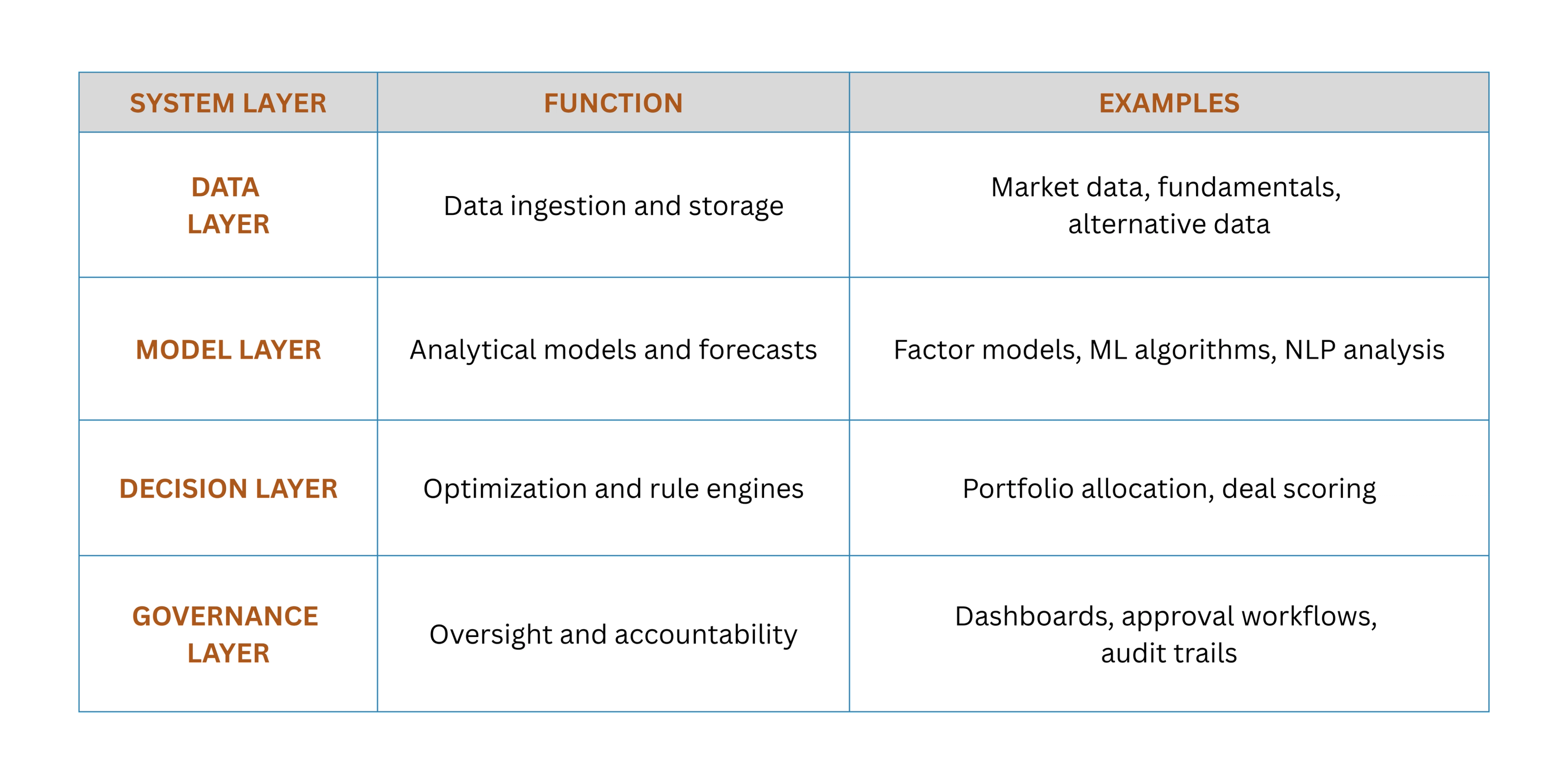
This architecture allows organizations to integrate large datasets, analytical models, and human oversight into a single structured decision pipeline.
Governance, Bias, and Human Judgment
Despite advances in automation and AI, human judgment remains central to investment decisions. Complex models can identify patterns, but strategic interpretation often requires contextual understanding that algorithms alone cannot provide.
AI also introduces governance challenges. Models may be difficult to interpret, particularly when complex neural networks generate predictions that are not easily explainable (IJRPR).
To address this, firms increasingly employ explainable AI techniques and formal governance frameworks that ensure model transparency, documentation, and regulatory compliance (Financial Stability Board).
Behavioral factors also continue to influence investment decisions. Research suggests that psychological and cultural influences can shape investor behavior, reinforcing the need for systems that combine data-driven analysis with disciplined oversight (ScienceDirect).
The Future of Investment Decision Systems
Looking forward, investment decision architectures are likely to become even more integrated and adaptive. Several trends are already shaping the next generation of systems:
- AI integration across the investment lifecycle, from idea generation to post-investment monitoring.
- Blending structured financial data with unstructured datasets such as text and behavioral signals.
- Greater emphasis on explainability and governance as regulatory scrutiny increases.
- More collaborative human–machine decision environments, where analysts and algorithms jointly shape outcomes.
Organizations that succeed will treat decision systems not as static tools but as evolving infrastructures, systems that continuously learn, adapt, and improve.
Investment decision-making has evolved from intuition-led judgment to highly structured analytical systems. What once depended primarily on individual expertise now relies on integrated architectures combining data engineering, quantitative modeling, artificial intelligence, and human oversight.
For investors, advisors, and corporate strategists, the strategic advantage increasingly lies in designing and operating these systems effectively. The ability to transform complex data into clear, disciplined decisions is becoming one of the defining capabilities of modern financial institutions.
At Yajur, the emphasis lies precisely on this intersection of research, analytics, and strategic decision support. By combining deep sector expertise with advanced analytical frameworks, Yajur Knowledge Solutions helps investors and advisory teams translate complex market intelligence into structured, actionable insights, ensuring that decisions are not only informed but systematically robust.
References
Acquire.com. AI in due diligence.
https://blog.acquire.com/ai-in-due-diligence/
AIMS Press. AI-driven portfolio recommendation systems.
https://www.aimspress.com/article/doi/10.3934/DSFE.2023009?viewType=HTML
Akira AI. AI agents in mergers and acquisitions.
https://www.akira.ai/blog/ai-agents-in-mergers-and-acquisitions
CFA Institute. How machine learning is transforming the investment process.
Financial Stability Board. Artificial intelligence and machine learning in financial services.
https://www.fsb.org/uploads/P091020.pdf
Hermes Investment Management. A history of quantitative investing.
https://www.hermes-investment.com/uk/en/institutions/insights/macro/a-history-of-quant/
International Journal of Research Publication and Reviews (IJRPR). Machine learning in finance (Vol. 6, Issue 3).
https://ijrpr.com/uploads/V6ISSUE3/IJRPR40605.pdf
LinkedIn. A brief history of quantitative investment management.
https://www.linkedin.com/pulse/brief-history-quantitative-investment-management-herbert-blank-wotje
LinkedIn. AI in mergers and acquisitions industry research.
Mackenzie Investments. The evolution of quantitative investing.
https://www.mackenzieinvestments.com/en/institute/insights/the-evolution-of-quantitative-investing
Malque Publishing. Applications of natural language processing in financial analysis.
https://malque.pub/ojs/index.php/mr/article/view/8201
ScienceDirect. Behavioral factors influencing investment decisions.
https://www.sciencedirect.com/science/article/pii/S2214845023000637
SmartDev. AI use cases in investment management.
https://smartdev.com/fr/ai-use-cases-in-investment-management/
Wikipedia contributors. Quantitative analysis (finance).
https://en.wikipedia.org/wiki/Quantitative_analysis_(finance)