
In mergers and acquisitions, the offer letter's multiple is only the beginning of the story. Behind it sits a forensic examination built around one deceptively simple question: are these earnings real, repeatable, and reliable once ownership changes hands? That examination - the Quality of Earnings, or QoE, review - has moved well beyond a back-office compliance step to become the terrain where deal value is genuinely won, lost, or quietly renegotiated.
For middle-market owners, M&A advisors, and corporate development teams, understanding what a QoE actually scrutinizes is no longer background knowledge; it is strategic necessity. A defensible earnings narrative preserves valuation and speeds closing, while an unsupported one invites retrades, earnouts, or a walked-away buyer.
Why QoE Has Become the Real Battleground
A QoE analysis occupies a different role than a financial audit. An audit asks whether historical numbers were prepared according to accounting standards; a QoE asks something more pointed - will a new owner actually receive this level of earnings, year after year, without the seller's personal involvement or a one-time windfall propping up the number.
That shift in framing turns the QoE from a verification exercise into a valuation mechanism: the adjusted EBITDA it produces becomes the denominator in the pricing equation, and every adjustment accepted or rejected moves enterprise value by a multiple of that amount.
QoE reviews are now standard across deal sizes and buyer types, private equity firms, strategics, and family offices alike commission them before finalizing an offer. For transactions using SBA 7(a) financing above $3 million, a QoE report became mandatory under SBA SOP 50 10 8.1 effective October 1, 2026, which requires not just EBITDA normalization but a “cash proof” reconciling bank statements to income statements and tax returns for the trailing twelve months and the prior two fiscal years - elevating QoE from a buyer's discretionary tool to a lender-mandated gatekeeper.
The commercial case for getting ahead of this is measurable: sellers who commission a sell-side QoE before going to market tend to achieve stronger multiples than those who do not, since a pre-vetted earnings number gives buyers the confidence to bid without discounting for uncertainty, while a majority of deals that enter diligence with unsupported add-backs experience some form of price adjustment once the QoE lands.
Inside a QoE Report
A typical QoE report runs twenty to fifty pages depending on deal complexity, and while formats vary by provider, the core structure is consistent. The executive summary is the most-read section, often the only one a senior decision-maker actually reads in full, and needs to answer three questions immediately: what is the normalized EBITDA, what are the top risks, and which adjustments should move price or terms. A strong summary presents that answer as a waterfall from reported net income through reported EBITDA to adjusted EBITDA, paired with specific, bulleted findings rather than vague commentary.
At the center of the report sits the EBITDA bridge, a line-by-line reconciliation from reported net income through every adjustment to the final normalized EBITDA, with each line labeled, quantified, and tied to source documentation so a buyer can independently trace it. Adjustments typically sort into four categories, each carrying a different evidentiary bar:
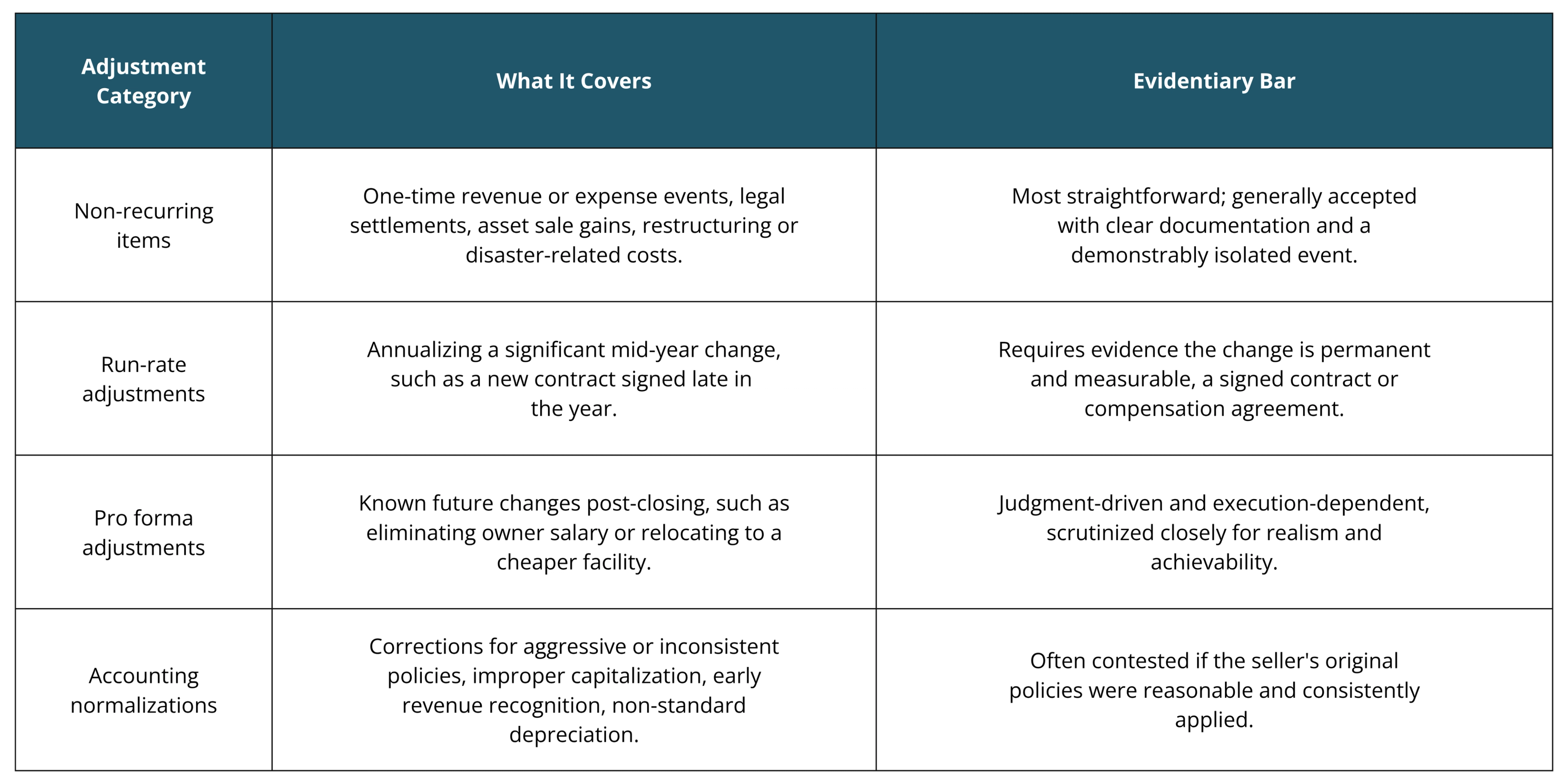
The credibility of the entire bridge depends on documentation quality. A defensible adjustment cites a specific invoice, contract, or payroll record; a vague lump-sum “management adjustment” without itemized support is the fastest route to rejection, and often invites broader skepticism about the rest of the financial presentation.
Revenue Quality and Customer Concentration
Revenue is the foundation of earnings quality, and a robust QoE dissects it by customer, product line, geography, and contract type over the trailing two to three years, separating recurring, contract-based revenue that will persist under new ownership from one-time project or channel revenue that may not repeat.
Customer concentration is a critical risk factor here: once more than 20–25% of revenue traces to a single customer or a small group, buyers perceive a dependency risk that cannot simply be diversified away post-closing, and businesses with top-customer concentration above roughly 30% commonly face valuation discounts in the range of 15–30% relative to more diversified peers, along with earnout structures or holdbacks to protect against worst-case churn.
Revenue recognition policy gets equal scrutiny, particularly for businesses with complex billing, SaaS subscriptions, long-term contracts, or milestone-based project work. Recognizing revenue before performance obligations are satisfied, booking one-time project revenue as if recurring, or shifting revenue between periods to smooth results are all patterns buyers actively test for; an unexplained spike in the final weeks of a quarter is a classic signal of cut-off risk or sales pulled forward, and findings like these routinely lead to EBITDA haircuts or earnout requirements rather than an outright rejection of the deal.
Margins, Add-Backs, and the Three-Part Test
Gross margin trends reveal whether profitability reflects a genuine operating advantage or something more temporary, underinvestment, favorable supplier terms that may not persist, or an accounting anomaly.
On the operating expense side, buyers review proposed add-backs for owner-specific or non-recurring costs but hold them to a consistent three-part test: is the adjustment real, meaning supported by documentation; is it genuinely non-recurring, meaning unlikely to happen again; and will it actually stay out post-closing, meaning it does not depend on the seller's continued involvement or the buyer's unique synergies.
Owner compensation normalization is a good example of an adjustment that usually passes this test - adjusting an owner's salary to market rate for the role is one of the most widely accepted add-backs, provided it is supported by real compensation data and does not normalize pay down to an implausibly low figure.
The Working Capital Peg: A Silent Value Transfer
One of the least understood but most financially material parts of a QoE is the net working capital peg, the level of working capital a buyer expects to receive at close, typically calculated as the average of normalized NWC over the trailing 12 to 24 months, adjusted for seasonality.
If actual closing NWC exceeds the peg, the buyer pays the excess dollar-for-dollar; if it falls short, the purchase price is reduced by the same amount. This single mechanism quietly transfers tens or hundreds of thousands of dollars at closing depending on deal size, and unlike an earnout, it is deterministic rather than contingent on future performance, which is exactly why sellers who understand their own peg early, rather than discovering it late in diligence, retain far more negotiating room.
Negotiation over the peg tends to center on three questions: the lookback period, how seasonality is treated, and which balance sheet items actually count as working capital. Sellers generally prefer a shorter lookback to capture recent efficiency gains; buyers generally prefer a longer one to smooth out anomalies.
Getting ahead of this by calculating an internal peg using the same methodology a buyer would apply, and comparing it against the projected closing balance sheet, gives a seller time to accelerate collections, manage payables, or adjust inventory before the number is locked in.
Proof of Cash: Where Earnings Meet the Bank Statement
For SBA-financed transactions, the QoE must now include a cash proof, a reconciliation tying the company's bank statements to its income statements and tax returns across the trailing twelve months and the prior two fiscal years, confirming that reported earnings actually landed in the bank rather than existing only as accounting entries.
The reconciliation ties three sources together, the general ledger, bank statements, and trial balance, and material discrepancies, such as deposits recorded in the ledger but absent from the bank, or expenses paid from personal accounts and never recorded, trigger deeper investigation and can end a deal outright. A proof of cash that cannot be reconciled is frequently treated as a fatal finding rather than a negotiable one, since it raises the question of what else in the financial presentation might not hold up.
What Survives Diligence and What Gets Rejected
Certain adjustments are accepted consistently across buyer types, provided they clear the documentation bar:
- Owner compensation normalized to market rate, supported by real compensation data.
- One-time professional fees tied to a specific, isolated engagement rather than an ongoing relationship.
- Gains from the sale of non-core assets, supported by purchase agreements and closing statements.
- Restructuring costs from a completed, discrete event rather than an ongoing optimization program.
- Disaster-related expenses, which are non-recurring by definition.
- Other categories are challenged or rejected in predictable patterns:
- Synergy add-backs that depend entirely on the buyer's own organization, which belong in the buyer's investment thesis, not the seller's EBITDA.
- Recurring costs relabeled as one-time - an expense that shows up every year is recurring, regardless of how it is described.
- Aggressive owner add-backs, including compensation normalized to an implausibly low figure.
- Revenue timing adjustments that shift results between periods or book one-time revenue as recurring.
- Capitalization changes designed purely to lift EBITDA, such as expensing costs that should never have been capitalized in reverse.
- Unsupported lump-sum adjustments with no itemized backup - the single fastest way for an entire bridge to lose credibility.
The Findings That Actually Kill Deals
Not every QoE finding moves adjusted EBITDA, but several categories are severe enough to trigger a walkaway, a sharp price cut, or unusually onerous terms. Unsupported add-backs that materially overstate normalized EBITDA are the most common deal-killer, when a seller proposes a large add-back but can only document a fraction of it, buyers are left choosing between a retrade and walking away, and the gap itself raises doubt about the reliability of everything else in the presentation.
Severe customer concentration, particularly where a handful of customers account for the majority of revenue, can be treated as unmanageable risk regardless of price. Weak cash conversion — strong reported EBITDA alongside genuinely poor operating cash flow — signals the same underlying concern from a different angle, and a proof of cash that will not reconcile is often the single most fatal finding a buyer can uncover.
Missing accruals, aggressive revenue recognition, and heavy owner dependency round out the list: none of these are automatically disqualifying on their own, but each one shifts negotiating leverage firmly toward the buyer.
How QoE Findings Actually Shape Deal Terms
QoE findings translate into four concrete negotiating levers. The most direct is the valuation multiple itself — unsupported add-backs, concentration risk, and weak cash conversion routinely compress the multiple a buyer is willing to pay. Earnouts are the typical response when a finding creates genuine uncertainty about future earnings rather than an outright disqualification, tying a portion of the price to performance over the following few years.
Holdbacks and escrows respond to a different class of risk — missing accruals, undisclosed liabilities, or working capital shortfalls — by reserving a portion of proceeds against issues that might surface after closing. And certain findings, such as an unresolved cybersecurity gap or an incomplete accrual schedule, can become outright closing conditions that a buyer requires the seller to remediate before the deal can complete at all.
A Seller's Pre-Deal Checklist
The best time to prepare for a QoE is well before a sale process begins, not once diligence is already underway and leverage has shifted to the buyer. Four steps consistently make the difference:
Commission a sell-side QoE before going to market, to surface documentation gaps and unsupported add-backs while there is still time to fix them.
Build an auditable EBITDA bridge early, with every adjustment tied to a specific invoice, contract, or payroll record rather than a round-number estimate.
Calculate the working capital peg on real trailing-twelve-month data, and compare it against the projected closing balance sheet with enough runway to correct a shortfall.
Map debt-like items, unpaid invoices, accrued bonuses, contingent liabilities — early, so nothing is discovered for the first time during a buyer's diligence.
Earnings Quality as a Strategic Asset
Quality of Earnings has stopped being a diligence formality and become a genuine determinant of deal outcome. Buyers are not searching for perfect financials — they are searching for defensible ones, earnings that hold up as real, repeatable, and reliable once new ownership takes over.
A business that can demonstrate that tends to command stronger multiples, faster closings, and cleaner terms; one that cannot tends to face retrades, earnouts, or a buyer who simply walks.
As SBA-mandated QoE requirements push this discipline further into the middle market, earnings quality has become less a compliance checkbox and more a genuine source of negotiating leverage, which is precisely why the sellers, advisors, and dealmakers who prepare for it earliest are the ones who keep the most value at the table.
References
Acquisition Stars. (2026, April 17). Quality of earnings reports: What buyers use them for.
Anders CPA. (2026, August 5). Quality of earnings (QoE) report: What it is (and why it matters).
Auxo Capital Advisors. (2025, September 19). Quality of earnings (QoE) in M&A: What buyers flag.
Bato. (2026, February 21). EBITDA adjustments and quality of earnings: The M&A buyer's guide.
Beancount. (2026, May 17). Proof of cash: Where profit meets reality in M&A.
Bonadio. (2024, November 13). Common QoE adjustments.
CLA Connect. (2026, January 6). Sell-side quality of earnings can help close a business sale.
Clearview QoE. (2026, June 25). What to expect during a quality of earnings engagement: The process from start to finish.
Consult EFC. (2026, February 5). Quality of earnings 2026, buyer tests, red flags, fixes.
CT Acquisitions. (2026, July 14). Quality of earnings (QoE) report: 2026 guide.
Evergrow Advisory. (2026, May 13). Quality of earnings: What buyers really look for.
Grant Thornton Switzerland. (2026, April 16). Understanding quality of earnings.
OGS Capital. (2026, September 13). Quality of earnings (QoE) checklist for M&A buyers.
OpsFi. (2026, April 6). EBITDA add-backs: Real vs inflated adjustments.
Peasebell. (2026, September 10). SBA 7(a) quality of earnings: What the new $3M rule requires.
Peony.ink. (2026, August 26). Quality of earnings in 2026: Add-backs, cost, and what sellers get wrong.
QoEAgent. (2026, August 31). What is a proof of cash and why it matters in M&A.
Stacking Capital. (2026, May 23). Quality of earnings (QoE) 2026: The complete guide for small business M&A.
Transaction Services Training. (2026, May 5). QoE report structure: What goes in an FDD report.
Valutico. (2025, September 27). Quality of earnings (QoE) adjustments: A guide for M&A deals.
V7 Labs. (2026, July 5). Quality of earnings analysis: The M&A due diligence guide.
BGH Valuation. (2026, August 28). SBA quality of earnings report requirements | SOP 50 10 8.1.