Modern dealmaking is awash in data. Financial statements, customer records, market reports, digital signals, and operational dashboards all promise to reveal the truth about a business. Yet access to information does not, on its own, produce better decisions. A buyer can hold thousands of rows of customer data and still misread the source of growth; a founder can present strong revenue and still leave a buyer unsure whether it is repeatable.
The gap between information and advantage lies in interpretation. Data describes what is happening; analysis explains why; insight clarifies what it means; strategy determines what should happen next. In a transaction environment where decisions are capital-intensive and often irreversible, moving cleanly through those stages is a genuine source of competitive advantage, and the point of data in a deal was never to produce more information, but to create greater conviction about what to do next.
The Data-Rich, Insight-Poor Deal Environment
Deal teams today operate with more information available to them than at any point before, yet more data can just as easily create more noise. Analysts can produce increasingly detailed reports while the central investment question remains unresolved, with strategy, commercial, and operational workstreams each generating separate conclusions that never quite integrate into a single deal thesis.
This pattern is not unique to M&A: research on data and analytics adoption finds that many organizations respond to data-driven competition through ad hoc initiatives rather than sustained strategic adjustment, while higher performers combine a formal data strategy, stronger data quality, and a culture that actually uses data in everyday decisions (McKinsey & Company, 2019).
The lesson for transaction professionals is direct, analytical capability creates value only when it is tied to a decision that actually matters, whether that is which targets belong on a list, what is really driving a company's growth, or which synergies are realistic enough to underwrite.
Start With the Question, Not the Dataset
The first step in turning data into strategy is not collecting more of it — it is defining the decision the data must support. Weak analysis tends to begin with an available dataset (“we have five years of financials”); strong analysis begins with a question (“what is actually driving this company's growth?”).
A useful structure carries that question through five stages: the decision the team must make, the hypothesis it currently holds, the evidence that could support or challenge that hypothesis, the implication if the evidence goes either way, and the action that follows. If a piece of analysis will not change a screening decision, a valuation assumption, or a negotiating position, it likely does not deserve the team's time.
Data, Analysis, and Insight Are Not the Same Thing
The three terms are often used interchangeably, but they represent different stages of reasoning. Data is an observation, revenue by customer, churn, order frequency, necessary but not self-explanatory. Analysis organizes that data to answer “what is happening”: segmenting customers, comparing margins, tracking cohort retention. Insight goes further, connecting the pattern to a business implication.
Consider a simple chain: the top 20 customers represent 55% of revenue; four of those customers have contracts expiring within 12 months and below-average margins; the insight is that revenue concentration is not just a customer-risk issue but a near-term quality-of-earnings and margin-renewal risk, which means the buyer should test renewal probability and pricing power before accepting the forecast as given. That final step, from observation to decision, is where research actually becomes useful to a dealmaker.
Building a Genuine Evidence Base
The strength of any conclusion is bounded by the strength of its evidence, and in M&A that evidence typically spans several categories at once. Internal company data — general ledger detail, customer-level revenue, pricing records, churn, often reveals patterns invisible at the consolidated level, where a business can report stable margins overall while individual customers or locations are deteriorating underneath.
External market data supplies the context needed to know whether a company's performance reflects genuine execution or simply rode a favorable market. Primary research — interviews with customers, suppliers, and former employees — adds color unavailable in any dataset; Bain describes this kind of fieldwork, combined with alternative data and M&A-specific analytics, as core to building a genuine understanding of a target's potential (Bain & Company, n.d.-a), though its real value comes from spotting recurring themes rather than treating any single interview as proof.
Alternative data - web activity, job postings, shipping signals - follows the same rule: the right test is never whether a dataset can be obtained, but which decision it will actually improve.
Why Segmentation Beats Averages
Averages are useful for orientation and dangerous for decision-making. A company reporting 90% gross revenue retention could represent a genuinely stable base, or a mix of loyal enterprise accounts masking severe churn among smaller ones, two situations that imply very different commercial strategies and valuation risk.
A 25% EBITDA margin can just as easily conceal a strong core business subsidizing a weak division, or a temporary benefit from underinvestment.
Segmenting by customer type, geography, product, or cohort converts a flattering headline into an actual map of the business, and the same discipline sharpens target screening: a real target landscape classifies companies by strategic fit, ownership profile, and transaction feasibility, turning an unfiltered spreadsheet into a prioritized set of hypotheses rather than just a longer list of names.
Due Diligence as Hypothesis Testing
Due diligence is often described as a verification exercise, but it functions more like hypothesis testing. A buyer starts with a preliminary view, built from management materials or an initial market read, and diligence then tests whether the claims behind that view actually hold up: is revenue growth sustainable, is pricing power real, are margins improvable, is the management team capable of executing the plan.
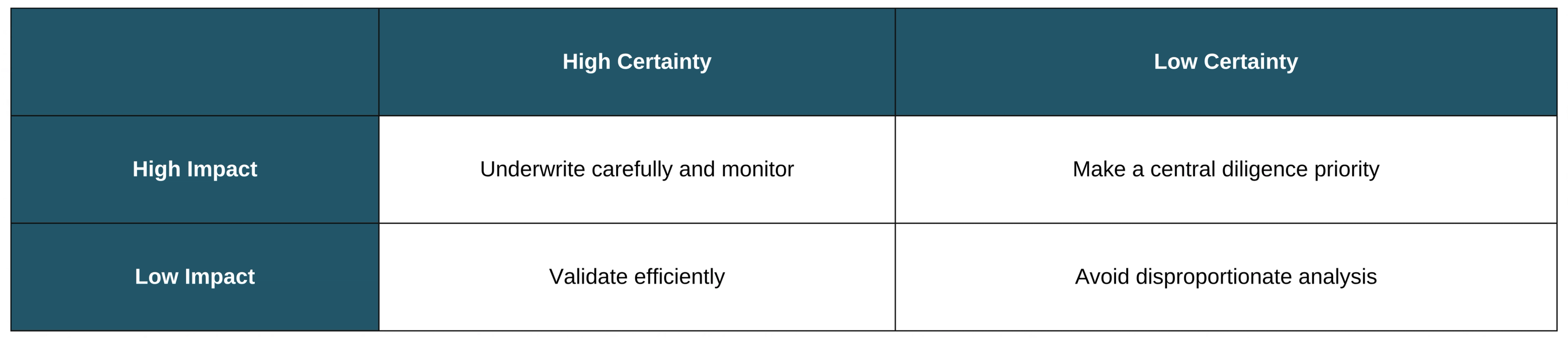
The task is not to prove every hypothesis; it is to identify which assumptions are both the most important and the most uncertain, and a simple prioritization matrix helps focus that effort.
Deloitte frames M&A analytics in similar terms — a way of asking more precise questions across the transaction lifecycle, from the true source of growth to where margin pressure is concentrated by customer, product, or location (Deloitte, 2024). Those sharper questions are what move diligence below the consolidated headline and toward the mechanism actually driving performance.
Integrated Diligence and the Connected Business
Business functions do not operate in isolation, and a siloed diligence process that examines strategy, commercial performance, and operations separately tends to miss exactly where they interact. Bain's research on integrated diligence found that across 65 mature private equity deals invested in after the global financial crisis, 71% of investments fell short of projected margins, with actual margins averaging 330 basis points below the original deal model, a gap Bain attributes in part to diligence that treated these workstreams as separate questions rather than one connected business system (Bain & Company, 2019).
A revenue opportunity that ignores the operating investment required to capture it, additional supply-chain capacity to meet a large retailer's delivery terms, for instance — is not a complete opportunity assessment. Integrated diligence asks what capabilities the growth actually requires, what happens to margins during the transition, and what the downside looks like if the plan slips.
Quality of Earnings: Testing What's Durable
Reported earnings and sustainable earnings are not automatically the same thing, and a quality-of-earnings analysis exists to separate the two — examining revenue recognition, customer concentration, one-time items, and owner-related costs to understand what a buyer is actually acquiring.
An apparent margin improvement might reflect a genuinely durable pricing gain, or it might reflect delayed hiring, capitalized costs, or a one-time customer project — each with a very different implication for valuation, debt capacity, and what management will need to do differently after closing. The relevant question for any adjustment is not simply whether an expense looked unusual, but whether the buyer will need to incur something similar once they own the business.
From Diligence to Value Creation
Diligence and post-close value creation are too often treated as two unrelated phases rather than one continuous thread. If diligence surfaces customer concentration, the operating plan should include specific retention actions; if it surfaces a pricing opportunity, someone should own segmentation and monitoring from day one.
Bain's private equity research frames effective diligence as providing both the conviction to invest and the foundation for an implementation-ready value-creation plan (Bain & Company, n.d.-b) — a connection that matters because value creation most often fails at the translation point between what diligence found and what the operating team actually executes. An observation like “pricing is below peers” only becomes useful once it is converted into an owner, a sequence of activities, an expected financial impact, and a way to measure whether it is working.
Where Technology and AI Actually Help
Technology can meaningfully accelerate the move from data to insight — organizing large datasets, screening targets, flagging anomalies, and summarizing diligence materials far faster than a manual process could. Deloitte's M&A analytics work describes using analytics and visualization to surface risks and insights across the deal lifecycle, from target screening through integration (Deloitte, n.d.-a).
But technology is not a substitute for judgment: an AI-generated summary can omit the one contract clause that changes everything, and a screening tool can elevate a company that fits a numerical profile but lacks strategic or cultural fit.
McKinsey's research on data and analytics leaders points to the same underlying requirement — a real strategy, genuine data quality, and a culture that consistently uses data in decision-making (McKinsey & Company, 2019) — and that requirement applies just as much to AI-enabled workflows as to any earlier generation of tools. The most effective use of AI in a transaction is not to remove expertise from the process, but to free experienced professionals to spend less time searching and more time interpreting and deciding.
A Practical Framework for Moving From Data to Deal
A repeatable process helps turn research into an actual decision rather than a longer report:
- Define the decision — state it in practical terms, not as a broad mandate to “understand the market.”
- State the thesis — write down what the team believes before the analysis begins, so it can be tested rather than assumed.
- Identify the evidence — map each part of the thesis to the specific evidence that would support or challenge it.
- Segment the data — break consolidated numbers into groups that reveal the mechanism behind the headline.
- Test relationships — examine how commercial, operational, and financial variables actually interact.
- Quantify the implication — estimate the effect on revenue, EBITDA, cash flow, or deal structure, even directionally.
- Convert insight into action — proceed, pause, adjust the model, or walk away.
- Track the thesis after close — carry the core assumptions into the integration plan and update them as real evidence arrives.
Applied consistently, this turns research into a living decision system rather than a one-time report — and an actionable resource like Yajur Knowledge Solutions' own blog library exists precisely to help deal teams put frameworks like this into practice (Yajur Knowledge Solutions, n.d.-b).
The Central Idea
A transaction is not made successful by collecting enough information — it is made successful by understanding which information matters, what it means, and how it should change the decision at hand. Data can show that revenue is growing; analysis can show where that growth comes from; insight can explain whether it is durable; strategy can determine how to extend it.
For investment banks, M&A advisors, private equity firms, and corporate development teams alike, the practical discipline comes down to three questions that every important conclusion should be able to answer: what evidence supports this, why does it matter, and what should we do next.
Answered consistently, research stops being background material and becomes what it was always meant to be — an instrument of strategic decision-making, and in a market where speed and conviction increasingly decide who wins the best opportunities, that discipline is one of the most valuable capabilities a deal team can build.
References
Bain & Company. (2019, October 21). Integrating due diligence to build lasting value.
Bain & Company. (n.d.-a). M&A due diligence consulting.
Bain & Company. (n.d.-b). Operational due diligence—Private equity.
Deloitte. (2024, October 3). iDeal—Defining M&A analytics.
Deloitte. (n.d.-a). M&A analytics.
McKinsey & Company. (2019, September 19). Catch them if you can: How leaders in data and analytics have pulled ahead.