Institutional fundraising is often framed as a search for money. That framing undersells what is actually happening. For a founder, the process marks a transition, from running a business on instinct, speed, and personal conviction, to running one that can withstand scrutiny from professional investors.
A founder can have a strong product, early customers, and a compelling personal story, and still not be ready for institutional capital. Readiness is not enthusiasm, and it is not a polished deck. It is the ability to show, with consistent evidence, that the problem is real, customers will pay, the business can outgrow its founder, the numbers hold together, the ownership structure can survive diligence, and the capital requested is tied to milestones an investor can actually test.
Capital Is Not a Substitute for Readiness
The most common fundraising mistake is treating capital as a cure for weakness. A founder may want funding to hire a sales team, build technology, or enter a new market and some of those may be legitimate uses. But investors want to know whether the money accelerates an already credible engine, or simply finances activity that has not yet produced a repeatable outcome.
A business with no evidence of demand does not become investable by raising money; a company with weak financial controls often becomes harder, not easier, to manage after a large round lands.
The strongest fundraising cases make the relationship between proof, remaining uncertainty, and milestones explicit, rather than presenting capital as an abstract requirement. Sequoia Capital's business-plan framework reflects the same discipline, anchoring a raise in company purpose, customer problem, market potential, and long-term vision rather than a headline number (Sequoia Capital, n.d.-a).
Seeing the Company Through the Investor's Lens
Institutional capital arrives through different channels - venture funds chasing rapid growth, private equity investors weighing cash flow and operational depth, family offices with broader mandates, and strategics evaluating technology or distribution fit. Despite these differences, most professional investors examine a company through a consistent set of overlapping lenses, summarized below.
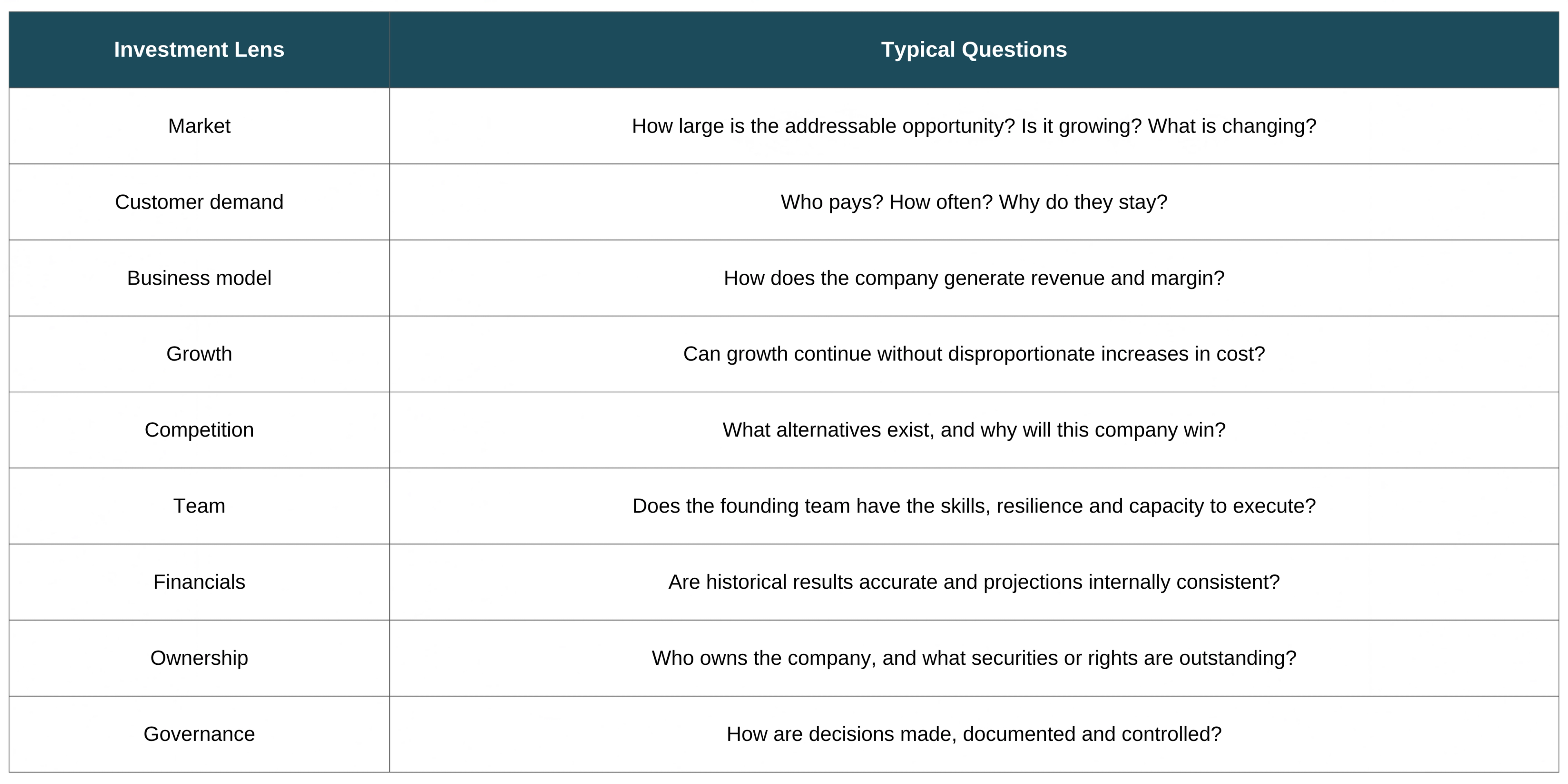
Stripe's overview of how venture investors evaluate opportunities describes a comparable process - assessing founders, markets, business models, traction, scalability, and fit with the fund's own mandate (Stripe, 2025).
That last point matters as much as any other: a company can be genuinely attractive and still be the wrong fit for a particular investor because of stage, sector, or cheque size. Founder readiness, in other words, includes investor targeting discipline - approaching funds that cannot write the relevant cheque is not ambition, it is inefficiency.
Strategic Clarity and the “Why Now” Test
A company cannot be investor-ready if its own direction is unclear. Investors do not expect a five-year plan free of uncertainty, but they do expect disciplined thinking: what the company does, who it serves, why the problem matters now, and what the next stage of growth requires.
Sequoia recommends founders lead with a single declarative statement of purpose rather than a list of features (Sequoia Capital, n.d.-a) - a customer-led description of the problem solved communicates far more than a feature list ever will.
Layered on top of that clarity is the “why now” test: what has genuinely changed - in cost, regulation, customer behavior, or infrastructure - that makes this opportunity timely rather than merely large.
A credible why-now argument needs four elements: an observable change, a customer problem that change intensifies, a solution suited to that problem, and a credible reason the company can capture value before competitors do (Sequoia Capital, n.d.-a). Without that fourth element, why-now is a macro slide, not an investment thesis.
Proof of Demand Beats Optimism
Institutional investors do not expect every early-stage company to have significant revenue, but they do expect founders to separate belief from evidence. Paying customers, renewal rates, signed contracts, and shortening sales cycles carry real weight; registrations, website traffic, and undocumented letters of intent do not. A useful traction metric is tied to customer behavior, measurable consistently over time, and plausibly connected to revenue or retention.
A common failure mode is the “metric collage” - a slide crowded with growth percentages, downloads, and press mentions with no hierarchy, which produces uncertainty rather than credibility.
The fix is to identify the handful of metrics that actually explain the business model: recurring revenue and net retention for a subscription business, take rate and liquidity for a marketplace, capacity utilization and yield for an asset-heavy company. The goal is not to present every available number, but the ones that explain the engine.
Financial Readiness as a Test of Management
Financial statements are not paperwork for accountants; they are a record of how well the founder actually understands the business. Institutional readiness rests on five questions: are the historical numbers reliable, do operating metrics reconcile with the financials, are forecasts built on explicit assumptions, does the company understand its cash needs, and can management explain deviations between plan and actual results.
A credible model connects operational drivers to outcomes - revenue explained through customers, pricing, and conversion rather than a top-line growth percentage - and should include scenario and sensitivity analysis. Venture due diligence frameworks commonly expect exactly this: financial projections, key ratios, and stress testing across multiple scenarios (OpenVC, 2025). Ambitious forecasts are welcome; forecasts an investor cannot trace back to an assumption are not.
The Cap Table Is a Strategic Document, Not an Afterthought
The capitalization table shows who owns the company, what securities they hold, and how future issuance affects that ownership. Stripe describes it plainly as the document outlining a company's ownership structure - shareholders, securities, and percentages - that should be updated every time the structure changes (Stripe, 2026a). For founders, a clean cap table underpins valuation negotiation, dilution analysis, voting power, and eventual exit proceeds.
Two weaknesses recur. The first is the informal equity promise - shares pledged to an adviser or early employee without proper documentation, which creates ownership uncertainty even before conversion. The second is a spreadsheet that no longer matches the company's legal records. An investor can usually absorb a clerical error; unexplained inconsistencies raise a harder question - if ownership records are unreliable, what else might be.
Governance, Legal Hygiene, and Sector-Specific Readiness
Governance is often mistaken for bureaucracy by early-stage founders; institutional investors tend to see it as a mechanism for protecting decision quality. It does not require a large corporate structure - only clarity about how important decisions are made, recorded, and reviewed: board resolutions, delegation of authority, conflict-of-interest disclosure, and regular management reporting.
This becomes especially important once the founder is no longer the sole decision-maker, since institutional capital typically brings reserved matters, consent rights, and formal reporting obligations that should be understood before signing, not after.
Legal diligence works the same way - less a defensive exercise than an opportunity to show the company genuinely owns and controls the assets that create its value: code, IP assignments, customer contracts, and regulatory approvals. Readiness also varies by sector. A fintech company must show licensing and know-your-customer controls; a healthtech company must show clinical and data-handling rigor.
For Indian founders accepting foreign investment, the Reserve Bank of India's foreign investment framework sets out requirements on the mode of investment and reporting of transactions (Reserve Bank of India, 2009), while companies raising capital through securities issuance should be conversant with SEBI's disclosure requirements under the ICDR regulations (Securities and Exchange Board of India, 2025).
The broader principle holds regardless of geography: institutional capital expects the company to understand the rules governing both its business and its financing, from day one rather than at the point of disclosure.
The Data Room and the Pitch Deck: Two Tests of Discipline
A data room exists to let an investor verify the company's claims efficiently. OpenVC frames due diligence as a comprehensive appraisal spanning business model, financial health, legal compliance, and market position, with the data room as the organized repository that supports it (OpenVC, 2025).
A useful test is simple: can the company's finance, legal, and operating records be located quickly by someone who did not create them? If not, the company is not yet ready for a demanding diligence process.
The pitch deck, meanwhile, is a compression exercise, its job is not to contain everything about the company, but to create enough understanding and curiosity for a deeper conversation. Sequoia recommends opening with what has changed, what the company does, and the essential facts of stage, traction, and raise size (Sequoia Capital, n.d.-b), before founders lose attention to a long company history or overbuilt market slide. A strong deck does not hide risk, it shows the founder knows exactly where the business is vulnerable and what the plan is to address it, and every important number in it should trace back to the underlying model rather than a headline market report (Sequoia Capital, n.d.-b).
Designing the Raise Around Milestones
A fundraising round needs a purpose specific enough to test. Hiring ten people or entering a new geography are activities, not milestones; the investor wants to know what those activities are meant to prove. The strongest raises tie capital directly to the company's central uncertainty - sales capacity if the open question is whether customers will pay, engineering investment if the question is whether the product scales, regulatory work if the question is approval timing.
Anchoring the use of proceeds to the risk that actually needs reducing, rather than a vague growth narrative, is what lets an investor understand what progress looks like once the cheque clears.
A Practical Readiness Framework
Founder readiness can be assessed across six dimensions, and the framework is only as strong as its weakest link:
- Investment thesis: Can the founder explain the problem, solution, market, timing, and long-term opportunity clearly?
- Commercial proof: Is there evidence of real demand - paying customers, retention, contracts - rather than vanity metrics?
- Financial control: Are the historical numbers accurate, and can management explain the assumptions behind the forecast?
- Legal and ownership hygiene: Is the cap table accurate, is IP properly owned, and are contracts and compliance records in order?
- Operating capacity: Can the company reliably deliver at the scale the plan assumes?
- Capital strategy: Is the amount raised tied to milestones, with an investor type suited to the company's stage and ambition?
A founder may have an excellent market thesis and weak ownership documentation, or strong revenue and thin management depth. Readiness is limited by whichever gap is most material, not by the strongest dimension.
Readiness Is a Habit, Not a Fundraising Event
The deepest misconception about investor readiness is that it can be assembled in the weeks before a round. A polished deck can be built quickly; twelve months of retention data, reliable financial reporting, and founder alignment cannot.
Readiness is really the byproduct of ongoing operating habits - monthly financial reporting, consistent KPI definitions, documented ownership, and honest review of plan versus actual performance.
These habits pay off even without a raise: they sharpen decision-making and give a founder optionality between equity, debt, partnerships, or simply waiting, rather than forcing a raise under pressure on weak terms.
What Institutional Readiness Really Means
Founder readiness for institutional capital is, at its core, a question of trust, that the problem is real, the evidence is meaningful, the numbers are accurate, and the team can respond to uncertainty. That trust is not created by design polish alone; it is created when the story, the numbers, and the documentation reinforce each other. The strongest founders do not present a flawless business.
They present one that knows what it has proved, what remains untested, and exactly how the capital will close the gap between the two - a discipline Yajur Knowledge Solutions works with founders to build well before a raise begins, including through resources like its own institutional investor checklist.
Readiness, ultimately, begins the moment a founder stops asking how to convince investors, and starts asking what a disciplined investor would need to know before committing capital, and whether the company can prove it.
References
OpenVC. (2025). The ultimate guide to venture capital due diligence.
Reserve Bank of India. (2009). Master circular on foreign investment in India.
Securities and Exchange Board of India. (2025). Frequently asked questions on Issue of Capital and Disclosure Requirements Regulations, 2018.
Sequoia Capital. (n.d.-a). Writing a business plan.
Sequoia Capital. (n.d.-b). How to present to investors.
Stripe. (2025). How venture capital firms work and what they look for.
Stripe. (2026a). Cap tables for startups: What they are and how they work.
Yajur Knowledge Solutions. (n.d.-a). Yajur Knowledge Solutions.
Yajur Knowledge Solutions. (n.d.-b). Funding Readiness 360°: The institutional investor checklist for startups.