
Mergers and acquisitions (M&A) have long been heralded as the ultimate strategic lever for growth, innovation, and competitive advantage. Yet, beneath the headline valuations and market optimism, history reveals a more nuanced story, one where some deals yield transformative value while others falter under the weight of misplaced expectations.
What separates value creation from value destruction in M&A? This question has preoccupied analysts, investors, and corporate leaders alike.
Drawing on insights from research and empirical data, this article distills the essence of value creation in M&A, from strategic intent to integration discipline, and explores why many deals fail to deliver on their promise.
The Essence of Value Creation in M&A
Value creation in mergers is not merely about cost efficiencies or revenue expansion. It is about creating an entity whose total worth surpasses the sum of its parts, a synergy that spans financial performance, strategic positioning, and operational resilience (Acquinox Advisors, 2024; ISBInsight, 2019).
The true differentiator lies in how organizations align vision, capability, and culture to extract enduring value.
Core Avenues of Value Creation:
- Synergies: Operational cost reductions and revenue expansion via innovation, cross-selling, and market adjacency.
- Market Expansion: Strategic access to new geographies, customer bases, or technology.
- Strategic Positioning: Vertical integration or acquisition of unique intellectual property and talent.
- Operational Excellence: Integration of systems, processes, and leadership discipline that enhances productivity.
Research shows that the most successful deals are designed not only to generate short-term financial results but to create long-term adaptability and innovation capacity (PwC, 2018).
Why Some Mergers Succeed: Determinants of Value Creation
1. Strategic Fit and Growth-Driven Motives
Deals rooted in strategic clarity and growth rationale tend to outperform opportunistic mergers (Wiley, 2025). Successful acquirers often focus on international diversification and core-adjacent expansion, leveraging synergies while maintaining operational focus (Econstor, 2021).
2. Realistic Synergy Planning
Empirical studies show that non-serial acquirers achieve measurable post-merger value when synergy assumptions are grounded in conservative benchmarks and supported by pre-close integration planning (DealRoom, 2024; SciEdu, 2013).
3. Cultural and Human Capital Integration
Culture remains one of the most underestimated success factors. Organizations that engage in early cultural due diligence and promote balanced partnerships report stronger post-merger engagement and innovation (Emerald, 2023; BCG, 2025).
4. Disciplined Integration and Measurement
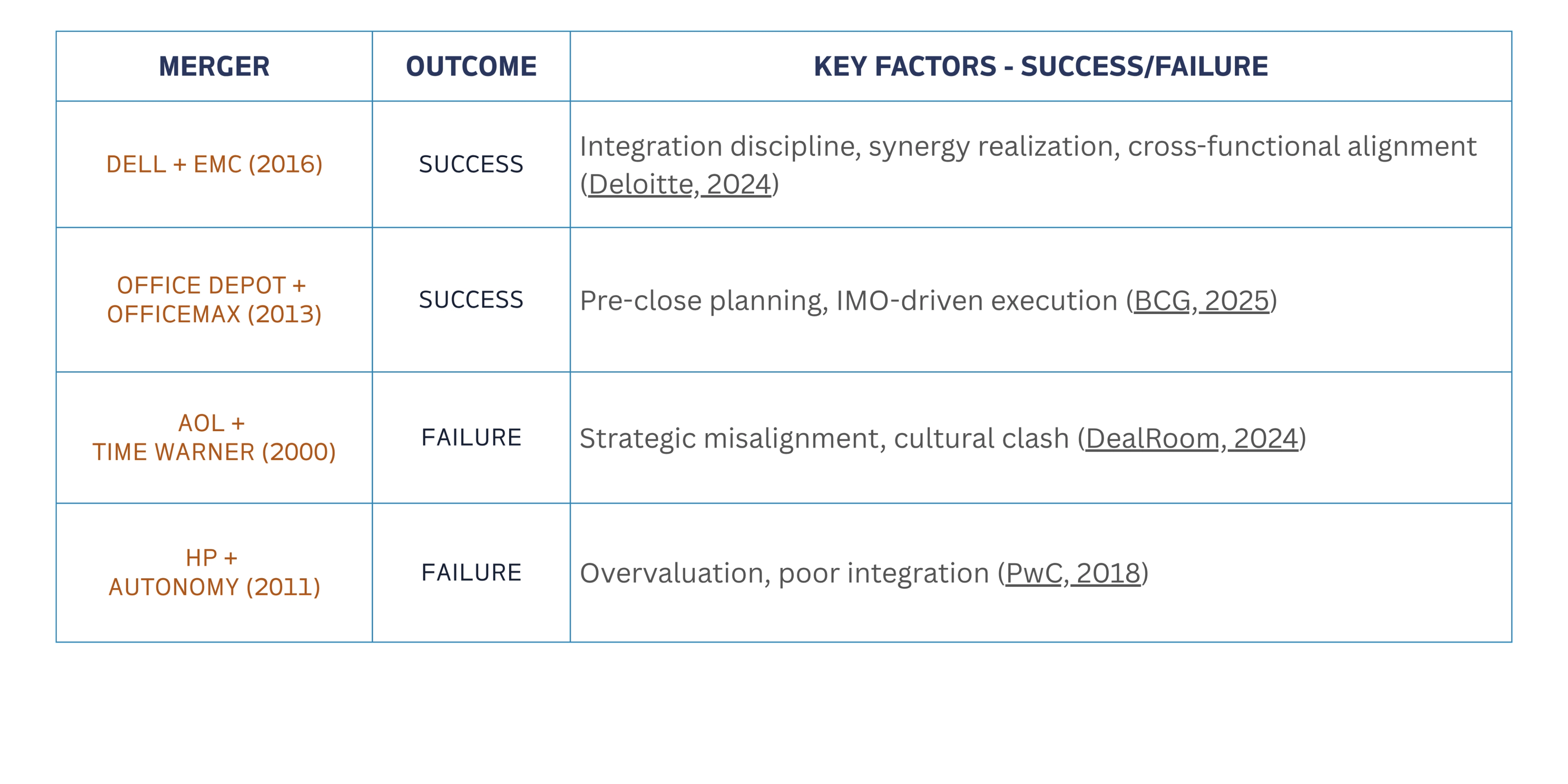
Integration excellence distinguishes enduring success from fleeting wins. The best-performing firms employ dedicated Integration Management Offices (IMOs), continuous metrics tracking, and agile feedback mechanisms (Deloitte, 2024).
Why Some Mergers Fail: Sources of Value Destruction
1. Overpaying and Unrealistic Expectations
Overestimation of synergies often leads to overpayment - the single biggest contributor to deal underperformance (DealRoom, 2024).
2. Inadequate Due Diligence
Incomplete diligence, financial, operational, or cultural - can expose firms to hidden liabilities or integration roadblocks (RocstrumLegal, 2023).
3. Cultural Friction
Neglecting the human dimension often leads to organizational dissonance, employee turnover, and customer loss (ISBInsight, 2019).
4. Weak Strategic Rationale
Deals pursued without a coherent strategic thesis often fail to create shareholder value. The AOL-Time Warner merger remains a classic example of misaligned strategy and cultural incompatibility (DealRoom, 2024).
The Empirical Paradox: Do Most Mergers Fail?
While traditional wisdom suggests that 60–80% of mergers fail (EFAJ, 2018), more recent studies argue that a majority of deals indeed create shareholder value, albeit unevenly distributed (Chicago Booth Review, 2016). The answer lies in measurement bias, what defines success varies widely across financial, operational, and strategic metrics.
Comparative Table: Lessons from Success and Failure
Best Practices for Sustainable Value Creation
Define a Clear Strategic Rationale - Anchor deals in long-term business purpose and measurable growth outcomes.
Adopt Conservative Synergy Models - Avoid inflated forecasts; focus on achievable metrics.
Embed Integration Governance - Use dedicated IMOs and real-time KPI dashboards.
Prioritize Cultural Due Diligence - Assess leadership alignment and employee engagement early.
Leverage Advanced Analytics - Use data-driven scenario modeling to refine valuations and integration pathways (Acquinox Advisors, 2024; BCG, 2025).
In the News
According to recent data from BCG, global M&A activity in 2025 shows a renewed focus on AI-driven integrations and cross-border collaborations, especially within the technology and sustainability sectors. Deals are now increasingly structured to capture digital synergies and stakeholder alignment from the start, a shift signaling the new frontier of value creation.
The success or failure of a merger is not determined by the ambition of the deal, but by the discipline of its execution.
M&A success lies in the fusion of strategy, culture, and data, a synthesis of logic and intuition, analysis and empathy. As organizations navigate this evolving terrain, those that blend insight, integration, and intelligence will redefine what sustainable value creation truly means.
At Yajur Knowledge Solutions, we believe the future of strategic finance and corporate growth will be shaped by data-empowered storytelling, where every decision is informed, every merger intentional, and every synergy designed to endure.
References
Acquinox Advisors. (2024). Value Creation in M&A. https://acquinoxadvisors.com/value-creation-in-ma/
BCG. (2025). Lessons from Eight Successful M&A Turnarounds. https://www.bcg.com/publications/2018/lessons-from-eight-successful-mergers-acquisitions-turnarounds
Chicago Booth Review. (2016). Forget What You’ve Read: Most Mergers Create Value. https://www.chicagobooth.edu/review/forget-what-youve-read-most-mergers-create-value
Deloitte Global. (2024). Technology M&A Case Study. https://www.deloitte.com/global/en/services/consulting-financial/case-studies/technology-m-and-a-case-study.html
DealRoom. (2024). Reasons Why Mergers and Acquisitions Fail. https://dealroom.net/blog/reasons-why-mergers-and-acquisitions-fail
Econstor. (2021). Capital Markets and Performance of Strategic Corporate M&A – An Investigation of Value Drivers. https://www.econstor.eu/bitstream/10419/254223/1/1794000186.pdf
Emerald Group Publishing. (2023). Making an M&A Work: Equal Strategic Partnerships Smooth the Path. https://www.emerald.com/insight/content/doi/10.1108/JBS-01-2023-0003/full/pdf?title=making-an-mampa-work-equal-strategic-partnerships-smooth-the-path
ISBInsight. (2019). Value Creation in Mergers and Acquisitions. https://isbinsight.isb.edu/value-creation-mergers-acquisitions/
PwC. (2018). Value Creation: Laying the Foundation for Mergers and Acquisitions. https://www.pwc.in/assets/pdfs/publications/2018/value-creation.pdf
RocstrumLegal. (2023). Value Creation Through Mergers and Acquisition. https://www.rostrumlegal.com/value-creation-through-mergers-and-acquisition/
SciEdu. (2013). Sources of Synergy Realization in Mergers and Acquisitions: Empirical Evidence from Non-Serial Acquirers in Europe. http://www.sciedu.ca/journal/index.php/ijfr/article/view/2654
Wiley. (2025). New Evidence on the Economic Motives for Bank Mergers. https://onlinelibrary.wiley.com/doi/10.1111/jfir.12471