
The lower middle market sits in a peculiar position: economically consequential, structurally underserved, and frequently misunderstood by both the capital markets that fund it and the advisory ecosystem that serves it. These businesses, typically generating annual revenues between $5 million and $50 million, with EBITDA ranging from $1 million to $10 million, form the operational backbone of many economies, yet face a cluster of financial challenges that larger public companies rarely encounter in the same configuration (Corporate Finance Institute, 2023; Verified Metrics, 2025).
In this context, a Quality of Earnings analysis is not merely a buyer's due diligence instrument. For lower middle market businesses, whether preparing for exit or seeking to strengthen their financial foundation, QoE functions as a structured diagnostic that brings precision, documentation, and credibility to a segment where the gap between reported and real earnings is often wider than most participants expect (Patriot Growth Capital, n.d.).
The Lower Middle Market: Definition and Economic Stakes
The lower middle market occupies the transitional zone between owner-operated small businesses and the institutionalized core middle market. Companies in this segment are beginning to professionalize operations but have not yet achieved the scale, capital access, or reporting infrastructure of larger enterprises (Delta Business Advisors, 2021; Visbl, 2026).
These firms are disproportionately represented in manufacturing, distribution, professional services, and niche technology. Their economic significance is substantial, forming a critical layer of enterprise value creation and employment that sits just below the radius of institutional capital markets and public company reporting standards (Corporate Finance Institute, 2023; Verified Metrics, 2025). Yet that importance is not matched by proportionate access to institutional capital, financial transparency, or advisory sophistication, and that gap is precisely where financial distress takes root.
A Sector at a Financial Inflection Point
The financial strain on lower middle market businesses has been accelerating. Analysis by Marblegate Asset Management and RapidRatings, covering over 1,200 private middle market companies, found that EBITDA fell more than 24% between 2019 and 2022 for private companies, while large public companies grew EBITDA by 18% over the same period. EBITDA margins declined 25% for middle market firms compared with just 2% for public companies, and net profit after tax fell nearly 80% against 33% growth at large firms (Business Insider, 2024).
The trajectory has continued to deteriorate. By 2024, average interest coverage had fallen to just 1.26x, with more than 20% of companies in the sample reporting coverage below 1x, meaning they could not cover interest obligations from operating earnings at all. Total liabilities rose over 70% since 2019, and the debt-to-EBITDA ratio expanded by 62% (PitchBook, 2025). Middle market companies are expected to see record bankruptcies in 2025 after reaching the highest levels since 2010 in 2024.
Rising interest rates compound the exposure. Unlike large public companies with access to fixed-rate bond markets, lower middle market firms typically depend on floating-rate bank financing, leaving them acutely vulnerable to rate volatility (Calvetti Ferguson, 2023). Against this backdrop, the ability to present clear, credible, and defensible financials is no longer a nice-to-have, it is a survival-level capability.
Ten Core Financial Challenges, and What QoE Does About Them
The financial vulnerabilities most common in lower middle market businesses are not random. They are structural. A rigorous QoE process addresses each of them directly.
1) Cash flow and working capital mismanagement.
Many lower middle market businesses report positive EBITDA while experiencing chronic cash shortages, a working capital problem, not a profit problem. Slow collections, excess inventory, mismatched payment terms, and absence of cash cycle visibility collectively create gaps that go unnoticed until they become crises. QoE builds an explicit EBITDA-to-cash flow bridge, revealing collection lag, inventory turnover, payment timing mismatches, and seasonality, and providing the operational insight needed to address each one (Auxo Capital Advisors, 2025).
2) Limited access to affordable capital.
Lower middle market businesses sit below the scale where institutional capital typically flows freely, yet above the threshold where owner financing and personal guarantees suffice. Lack of financial transparency is frequently cited as a primary barrier: lenders and equity investors cannot underwrite what they cannot understand (Jacobs Capital Advisory Group, 2025). QoE forces the business to reconcile financials to the general ledger, document accounting policies, organize add-back evidence, and build working capital schedules, a level of discipline that directly improves bankability and lender confidence.
3) Rising interest rates and debt costs.
QoE analysis examines the company's debt structure, interest coverage, and sensitivity to rate changes, calculating interest coverage ratios, debt-to-EBITDA, and fixed versus floating rate exposure. This enables proactive refinancing strategies: locking in fixed rates, extending maturities, or reducing leverage before coverage deteriorates further (Calvetti Ferguson, 2023; PitchBook, 2025).
4) Inability to pass through cost increases.
Weaker pricing power and contractual constraints have produced severe margin compression for middle market firms (Business Insider, 2024). QoE tests margin sustainability by examining gross margin by product or service line, pricing trends, customer retention, and win-loss data, distinguishing structural margin strength from temporary tailwinds (Auxo Capital Advisors, 2025).
5) Liquidity constraints and hidden liabilities.
QoE surfaces off-balance-sheet liabilities that can surprise buyers and undermine post-close liquidity: deferred revenue, unfunded obligations, equipment replacement backlogs, and customer deposits not yet earned. By quantifying these items before a transaction, sellers can negotiate their treatment proactively rather than reactively (Jacobs Capital Advisory Group, 2025).
6) Financial reporting and accounting quality.
Many lower middle market businesses operate without audited or even reviewed statements. Inconsistent expense classification, weak accruals, unreconciled bank accounts, and commingled personal and business expenses create diligence friction and give buyers reasons to discount value, even when the underlying business is healthy (Auxo Capital Advisors, 2025). QoE provides a roadmap for cleaning up the chart of accounts, implementing consistent accrual policies, and producing reliable financial reporting going forward.
7) Revenue recognition and timing problems.
Revenue timing issues are the most common finding in lower middle market QoE engagements, appearing in approximately 68% of transactions (MF Row, 2025). Pulling forward contract payments, billing in advance of delivery, and inconsistent percent-complete accounting for project-based businesses can all inflate trailing twelve-month revenue without technically misrepresenting annual totals. QoE tests cut-off, contract terms, billings versus delivery, and WIP treatment, and requires sellers to prepare a revenue recognition memo reconciling policy to actual invoices, contracts, and cash receipts (Auxo Capital Advisors, 2025).
8) Add-back inflation and unsupported adjustments.
Add-back inflation, where sellers include items that do not qualify as truly non-recurring or discretionary, appears in approximately 61% of QoE engagements (MF Row, 2025). The median adjustment to seller-stated EBITDA in lower middle market transactions is 15–22%, meaning a business presenting $2 million of EBITDA might see a QoE-adjusted figure of $1.6 million to $1.7 million before negotiations even begin. QoE tests every add-back against four criteria: Is it truly non-recurring? Is it documented? Is it removable post-close? Is it clearly non-business? The more evidence the seller provides in advance, the less room buyers have to reframe adjustments after exclusivity (Auxo Capital Advisors, 2025).
9) Related-party transactions at non-market rates.
Related-party transactions are found in approximately 47% of QoE engagements, leases, management fees, or service agreements between the business and entities owned by the seller or family members, often at terms that do not reflect arm's-length pricing (MF Row, 2025). QoE scrutinizes whether terms are at market rates, whether arrangements are necessary for operations, and whether they are properly disclosed, allowing sellers to normalize, terminate, or document them before buyers discover the discrepancy independently.
10) Deferred expenses and future cash obligations.
Deferred expenses that reduce current-period costs but represent real future cash outflows, delayed maintenance, postponed software upgrades, accrued but unpaid bonuses, are found in approximately 54% of engagements (MF Row, 2025). By quantifying these obligations, QoE allows buyers to adjust valuation or negotiate holdbacks, and gives operators a clear view of where cost deferral has temporarily boosted earnings at the expense of future cash flow.
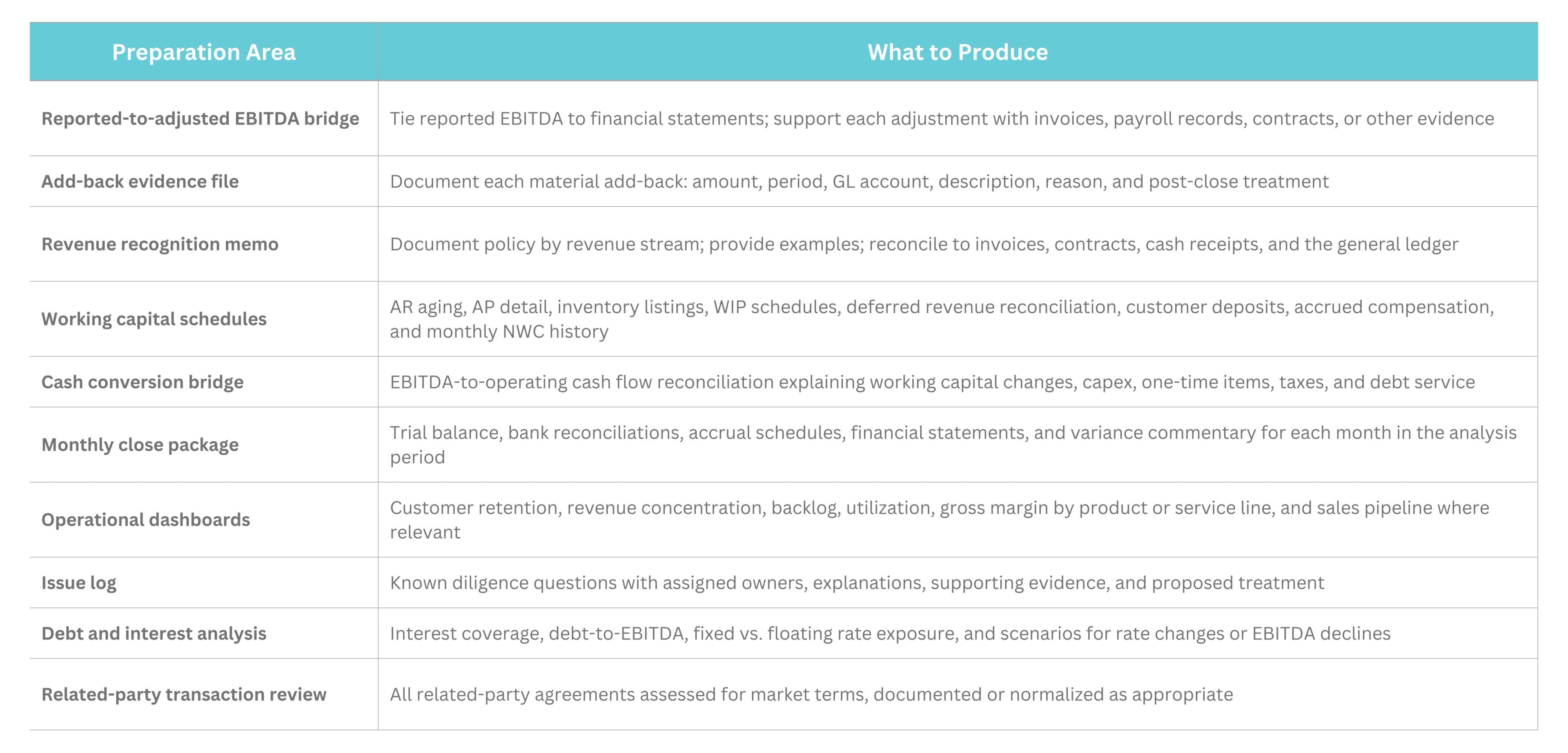
The QoE Preparation Checklist
The Valuation Case for Sell-Side QoE
The strategic value of a sell-side QoE extends well beyond process efficiency. According to GF Data's Full-Year 2025 Key Deal Terms Report, transactions that went to market with a sell-side QoE report achieved an average TEV/EBITDA multiple of 7.6x, compared with 6.6x for transactions without one, a full 1.0x multiple premium that represents meaningful value at virtually any deal size in the lower middle market (Windes, 2026).
Sellers who commission a sell-side QoE before going to market also control the narrative from the outset, reduce the probability of re-trades when buyers discover issues late in the process, and shorten the overall diligence timeline by pre-answering the questions buyers would otherwise spend weeks asking (Bennett Thrasher, 2024). That combination, higher multiples, lower re-trade risk, faster close, makes QoE preparation one of the highest-ROI activities available to a lower middle market seller.
For operators not yet preparing for exit, the same discipline applies. QoE-style internal reviews improve cash flow management, strengthen financial reporting, optimize capital structure decisions, and provide a grounded view of whether strategic initiatives are actually delivering what the income statement appears to show (Patriot Growth Capital, n.d.).
Lower middle market businesses face a formidable and structurally distinctive set of financial challenges: cash flow mismanagement, constrained capital access, interest rate exposure, margin compression, weak financial reporting, and earnings that frequently diverge from what the income statement implies. These are not incidental problems, they are the predictable consequence of operating at a scale where institutional infrastructure has not yet been built but institutional scrutiny is beginning to arrive.
A QoE analysis addresses each of these challenges with precision and evidence. It does not change the underlying business overnight. What it does is replace ambiguity with documentation, optimism with normalization, and seller narrative with independently supportable fact, the conditions under which value is both credibly presented and credibly defended.
In a capital environment where flows are increasingly concentrated in strong, transparent businesses, the discipline that QoE brings is not optional for lower middle market companies aiming to transact well or grow sustainably. It is foundational.
Yajur Knowledge Solutions partners with investment banks, M&A advisors, private equity firms, and corporate development teams to deliver the research rigor and financial precision that lower middle market deal execution demands. From building defensible adjusted EBITDA narratives to stress-testing working capital dynamics, revenue quality, and off-balance-sheet exposures ahead of a transaction, we bring the analytical depth of a sophisticated financial advisory practice to every engagement, supporting better diligence, stronger valuations, and more confident deal decisions.
References
Auxo Capital Advisors. (2025, September 18). Quality of earnings (QoE) in M&A: What buyers flag.
Bennett Thrasher. (2024, July 24). Sell-side quality of earnings: Why it's important.
Business Insider. (2024, January 9). There's a hidden crisis hurting mid-sized companies.
Calvetti Ferguson. (2023, July 9). Middle market challenges: Higher debt costs.
Corporate Finance Institute. (2023, May 29). Lower middle market — Overview, sources, takeaways.
Delta Business Advisors. (2021, May 27). Lower middle market — LMM.
Jacobs Capital Advisory Group. (2025, January 12). JACO helps middle-market businesses overcome 6 common challenges.
MF Row. (2025, April 21). Quality of earnings report: Complete guide for ETA buyers.
Patriot Growth Capital. (n.d.). Quality of earnings in private equity acquisitions.
PitchBook. (2025, July 16). Middle market private companies may see record bankruptcies in 2025: Marblegate.
Verified Metrics. (2025, May 1). Lower middle market.
Visbl. (2026, April 8). What is the middle market? Definition, size and why it matters.
Windes. (2026, June 28). Sell-side quality of earnings drives higher valuations.