
Valuation gaps have long been a defining friction point in mergers and acquisitions (M&A). Whether driven by differing market outlooks, fluctuating macroeconomic conditions, or divergent expectations of future performance, these gaps often derail promising transactions.
Yet, in today’s market, marked by volatility and evolving risk profiles, the ability to creatively structure deals has never been more essential (ClientWise).
This blog explores the evolving toolkit for bridging valuation gaps, highlighting innovative mechanisms, market-tested approaches, and the lessons firms can draw from today’s complex dealmaking environment.
Why Valuation Gaps Persist
- Divergent Market Expectations: Sellers often base valuations on future potential, while buyers anchor to current performance.
- Macroeconomic Volatility: Inflation, tariffs, and shifting monetary policy introduce new layers of uncertainty (Reuters).
- Risk Appetite Mismatch: Institutional investors may prefer conservative assumptions, whereas founders or PE-backed sellers may push for aggressive multiples.
Such persistent divides necessitate the use of structures that balance risk and reward equitably.
Creative Structures to Bridge Gaps
Innovative structures are now central to deal execution.
Several approaches stand out :
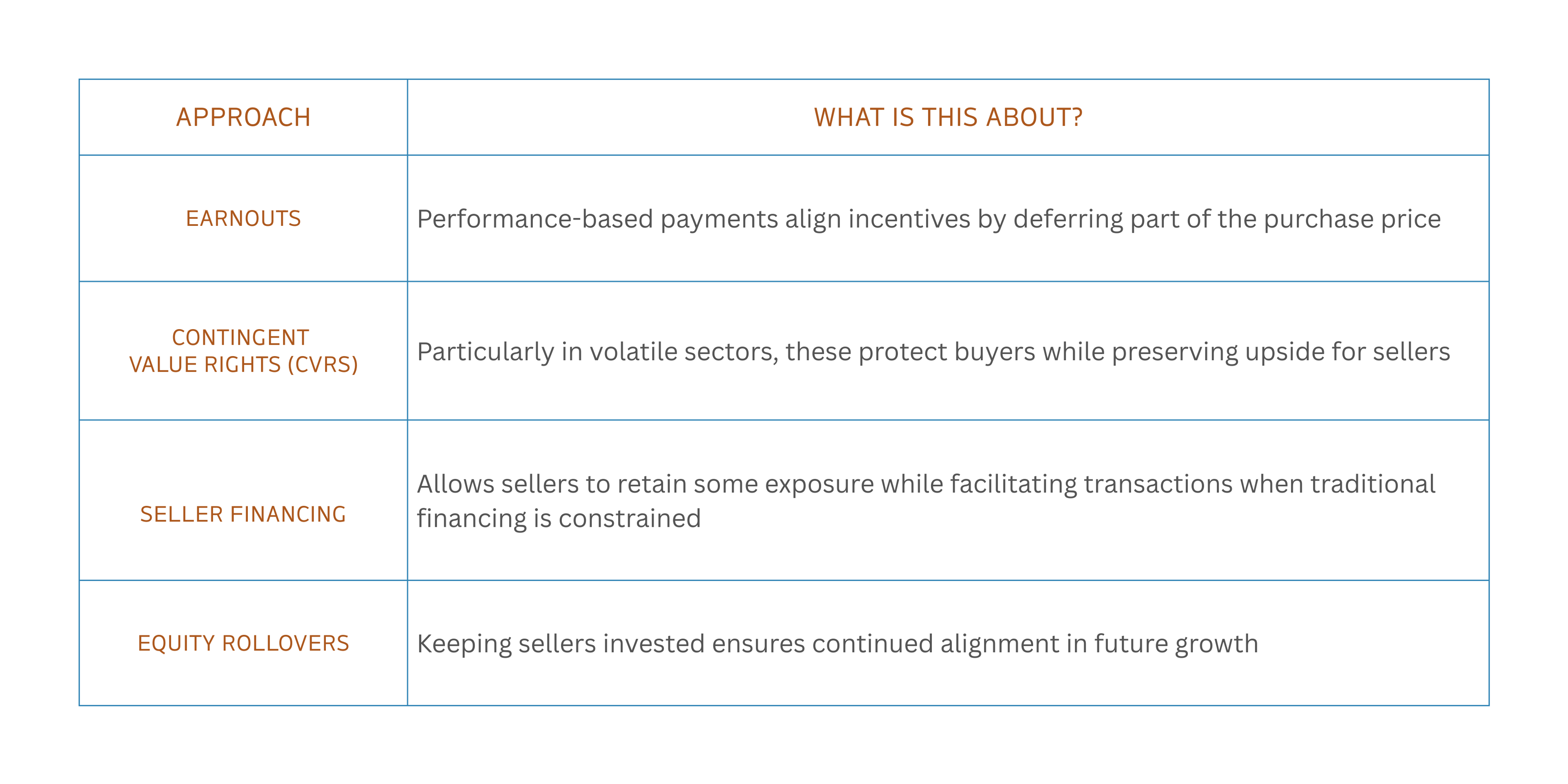
These mechanisms mitigate perceived risks while sustaining momentum in negotiations.
The Strategic Value of Creativity
Creative structures are not just financial engineering; they also address deeper transaction dynamics:
- Regulatory Headwinds: Deals in highly scrutinized sectors require adaptive frameworks to anticipate regulator concerns (Seyfarth).
- Behavioral Considerations: Bridging gaps often requires balancing psychology and trust, not just numbers (MA Science).
- Long-Term Value Creation: Flexible structures can preserve partnerships and enable smoother integration (McM Capital).
Emerging Trends
Risk-Sharing in Tariff-Sensitive Industries: CVRs and contingent payments are increasingly applied in sectors exposed to trade volatility (Reuters).
Increased Use of Data and Analytics: Advanced analytics sharpen performance-linked structures and stress-test assumptions (Datasite).
Evolving Legal Frameworks: Law firms are adapting contract language to accommodate more nuanced contingent provisions (Emerald Insight).
In M&A, the ability to bridge valuation gaps is no longer optional, it is central to execution excellence. Creative deal structures mitigate risk, foster alignment, and ensure transactions move forward even in uncertain times.
For forward-looking firms, the challenge is clear: creativity must be institutionalized as part of the dealmaking toolkit.
At Yajur Knowledge Solutions, we support global dealmakers by designing data-driven, tailored solutions that enhance precision in negotiations and execution. Our expertise in financial modelling, deal marketing, and execution support ensures that valuation challenges become opportunities for innovation.
References
- ClientWise. (n.d.). Bridging the valuation gap.
- ShareVault. (n.d.). Bridging valuation gaps with creative deal structures.
- Firmex. (n.d.). Creative dealmaking.
- MA Science. (n.d.). How to bridge valuation gaps in M&A.
- Datasite. (n.d.). The new architecture of M&A: Creative deal structures for risk management.
- PCE Companies. (n.d.). 9 M&A deal tactics to bridge the valuation gap.
- Reuters. (2025, May 2). Navigating tariffs in M&A transactions: Bridging valuation gap with contingent mechanisms.
- McM Capital. (2020, April). Creative deal structures for extraordinary times.
- Seyfarth. (n.d.). Mergers & acquisitions flipbook.
- Emerald Insight. (n.d.). Bridging valuation gaps.